Co-ownership charges in Belgium: what you pay and who is liable
Your share of a Belgian building's costs follows the quotas in the deed, not floor area or head count. How the bill is built, when the split can change, and what happens if you let or sell.
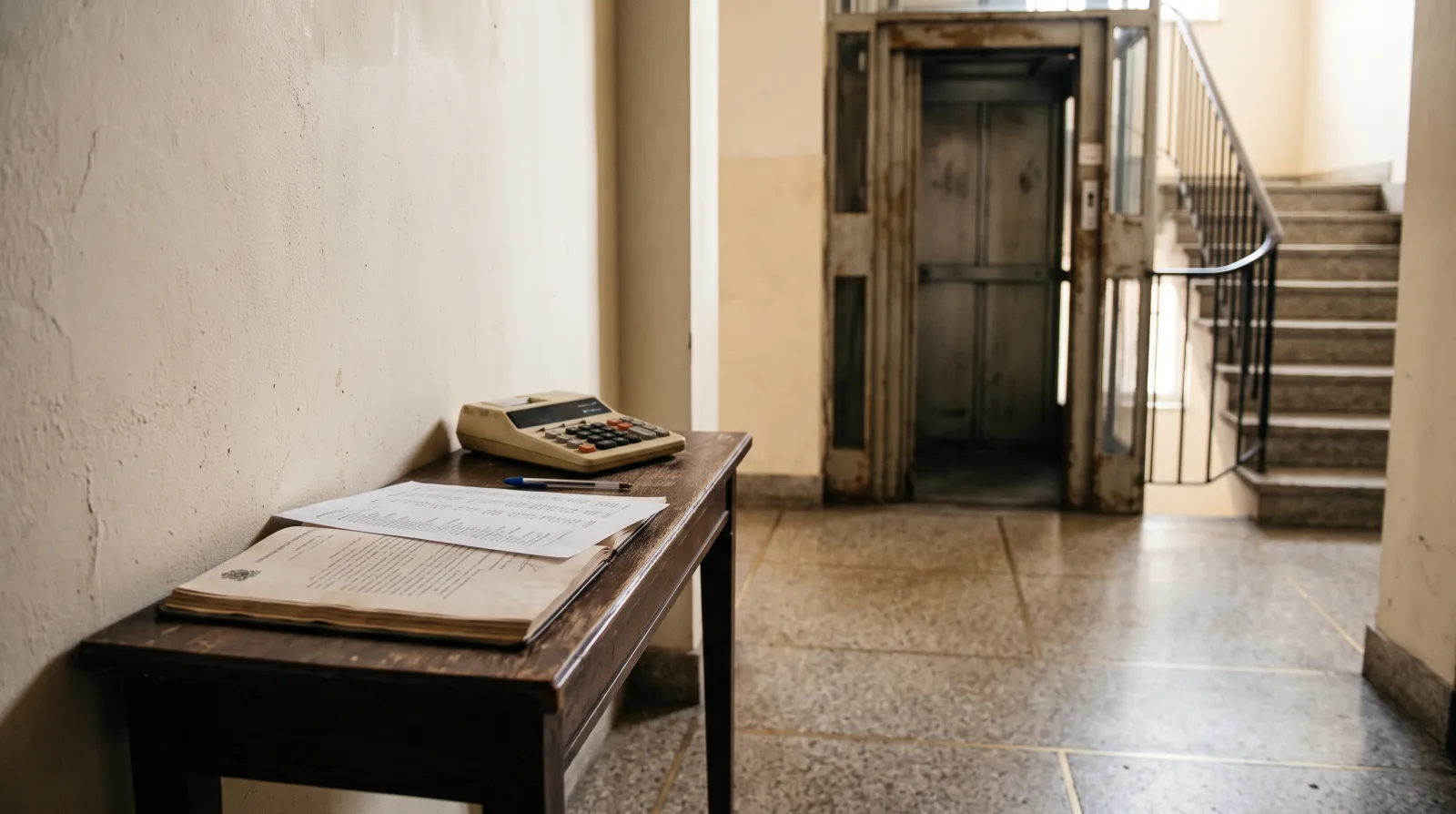
Three months after buying a second-floor flat in Brussels, the new owner gets her first statement from the syndic: 600 euros for the quarter. The couple on the top floor pay 696, the ground floor 528. Nobody has made a mistake. The building is one we made up to run the numbers (eight flats, a yearly budget of 19,200 euros), but the arithmetic is the one every Belgian block uses.
Charges in a Belgian co-ownership are divided according to the respective value of each lot, expressed as quotas (quotités in French, quotiteiten in Dutch) in the base deed, unless the co-owners have chosen to divide them by how useful each shared part is to each lot, or to mix both tests (article 3.81 of the Civil Code). Our owner holds 125 quotas out of 1,000, so she carries 12.5 % of every shared bill, lift included.
Two funds on every call for payment
The law names two pots the owners' association must hold at a minimum (article 3.86, § 3). The working capital (fonds de roulement, werkkapitaal) is made of advances for recurring costs, and the text gives heating and lighting of the common parts, management fees and the caretaker as examples. The reserve fund (fonds de réserve, reservekapitaal) builds up for costs that do not come round every year: a new heating system, a lift repair, a new roof covering. From five years after the common parts are handed over, the yearly contribution to the reserve cannot be lower than five per cent of the previous year's ordinary common charges, unless the general meeting votes by four fifths not to set one up. The two funds sit in separate bank accounts in the association's name, and each call for payment must say how much goes to the reserve.
That split matters when you sell.
Your share of the working capital is refunded to you and called from the buyer, while your share of the reserve fund stays with the association (article 3.94, § 5). The buyer bears ordinary charges from the day they can use the common parts, and the notary withholds any arrears you owe from the sale price (article 3.95). How the meeting that votes the budget works is covered in our guide to the general meeting of a Belgian co-ownership.
Can the split be changed?
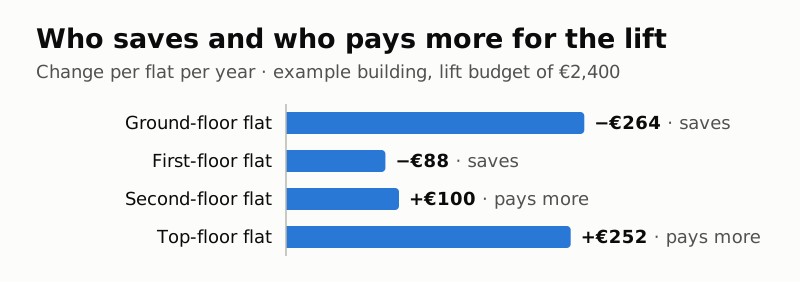
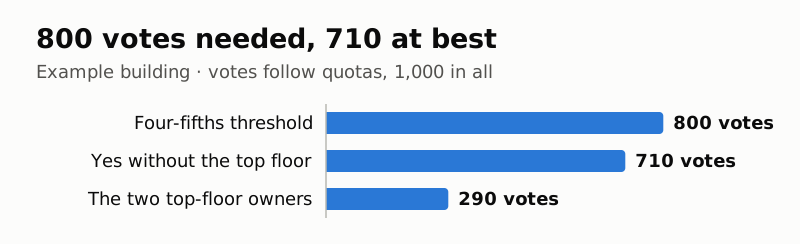
Yes, and the threshold depends on what you touch. Changing how charges are divided takes four fifths of the votes of the owners present or represented, abstentions left out (article 3.88, § 1, 2°). Changing the quotas themselves takes every single co-owner. The classic request comes from the ground floor, who would rather not pay for a lift they never use. In our building the lift costs 2,400 euros a year. Exempting the ground floor and weighting the rest by floor would save each ground-floor flat 264 euros and each first-floor flat 88, while each second-floor flat would pay 100 more and each top-floor flat 252 more. Votes follow quotas, so 800 out of 1,000 are needed, and the two top-floor owners hold 290 between them. If they say no, the motion stops at 710. Two further points tend to surprise newcomers. A change of key amends the building's statutes, which requires a notarial deed. And owners who are exempted from the cost of a shared part no longer vote on decisions about it (article 3.87, § 6).
If a split harms you personally, you can ask the justice of the peace to correct it (article 3.92, § 7).
If you let the flat
The association only ever bills the owner. What you may pass on to a tenant is set by the Region, because residential leases are regional law:
- Flanders: costs tied to ownership are the landlord's, costs tied to use are the tenant's (article 36 of the Flemish Housing Rental Decree). The government's non-exhaustive list puts the syndic's fee at 34 % tenant and 66 % landlord, splits routine lift maintenance in half, and leaves meeting costs, administration and the reserve fund with the landlord (annex 2 to the decree of 7 December 2018).
- Brussels: since 1 November 2024 a tenant owes only the items named one by one in the lease (new or exceptional charges aside), and the lease must set out the key used to divide the charges (article 224/3 of the Brussels Housing Code).
- Wallonia: the written lease states the amount and nature of the common charges and, in a multi-unit building, how they are calculated and divided (decree of 15 March 2018, article 3).
In all three Regions the property tax (précompte immobilier, onroerende voorheffing) cannot be charged to a tenant who lives in the flat as a main residence. Ask your syndic for a yearly statement broken down by item rather than one total per quarter, because every one of these rules works item by item. Where the building is run by its owners, a careful spreadsheet does the job, as does community management software such as Vecinly, which ties each payment to a unit.
One last case: a flat held in usufruct. The usufructuary and the bare owner are jointly and severally liable to the association for the charges, so the syndic may claim the full amount from either (article 3.86, § 3).
Before your first general meeting, find your quotas in the base deed and multiply them by the approved budget. If the figure does not match your statement, ask which key was applied to which item. And if your building has no professional manager, our guide to the volunteer syndic in Belgium explains who does what.
Legal texts checked on 8 October 2026 against the consolidated Civil Code (Book 3) and the three regional lease laws. This article is for information only and is not legal or tax advice.
Available in 3 languages
Keep reading



Try the specialized platform for your community
Organize maintenance, communication and management easily.