Community fees in Spain: what they cover and who pays
Your share is set by a percentage in the building's deed, not by a vote. What the fee covers, why the owner is always liable, and what changes if you rent out, buy or sell.
The first community bill on a Spanish flat usually raises one question: why does the neighbour downstairs pay less? Because fees here are not split per head. Each owner pays according to the participation quota (cuota de participación) written into the building's deed, unless the deed or the statutes set a different split (article 9.1.e of the Horizontal Property Law). Changing that split takes a unanimous vote (article 17.6).
What the annual meeting does vote on, by majority, is the budget.
What the fee covers, and what your quota is
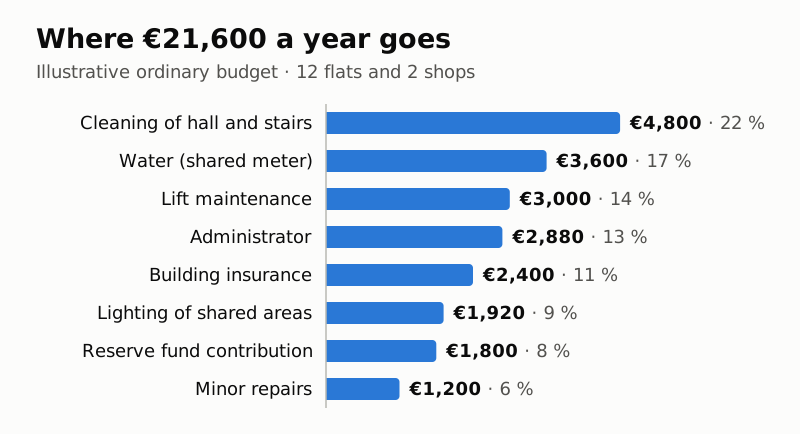
The ordinary fee pays for the running costs nobody can pin on a single flat: cleaning and lighting of the shared areas, the lift contract, building insurance, the administrator if there is one, and the contribution to the reserve fund. One-off works are billed separately as a derrama; see our guide to the reserve fund and special levies.
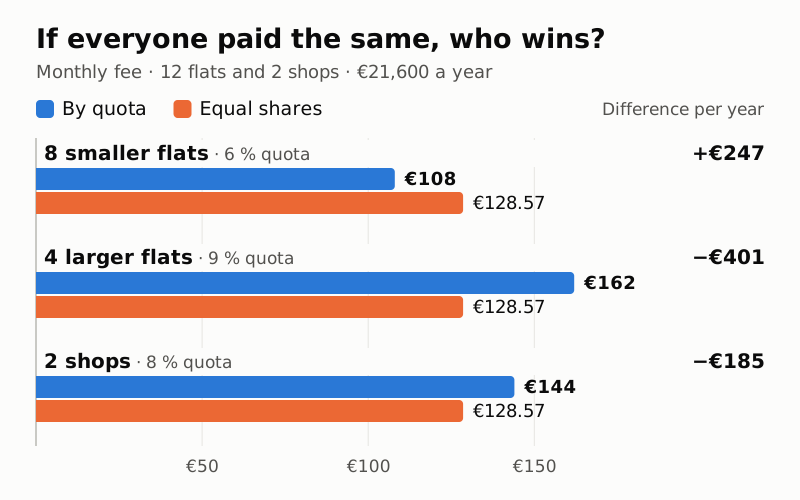
Your quota is a percentage fixed when the building was first sold off flat by flat. Article 5 tells the developer to base it on usable floor area, whether the unit faces the street or the courtyard, its position and the use it is expected to make of the shared services. You will find it in the deed of horizontal division and on the land registry extract for your flat. On a 21,600 euro budget, a flat with a 6 % quota pays 108 euros a month and one with 9 % pays 162. That gap is the reason proposals to charge everyone the same keep failing: the owners of the smaller flats would pay more, and a single one of them voting no is enough to block the change. Not using something is no way out either. The same law says that not using a service does not release you from paying for it, so a ground-floor shop pays towards the lift unless the deed or the statutes expressly exempt it.
Catalonia has its own civil code and is more flexible: there the meeting can approve special quotas for particular costs with a four-fifths majority (article 553-26).
The owner is always the one the community bills
Letting someone else live in the flat does not move the debt. The community claims from the owner, and who bears the cost in the end is a private matter between the owner and the other party.
| Situation | The community claims from | Between themselves |
|---|---|---|
| Flat rented out | The owner | The tenant, only if the lease says so in writing and states the annual amount (art. 20 of the Urban Leases Act) |
| Usufruct | The bare owner | The usufructuary pays the yearly charges; extraordinary repairs fall on the owner (arts. 504 and 501 of the Civil Code) |
| Sale | The seller up to completion, the buyer afterwards | Whatever the deed of sale says |
| Divorce | Whoever is on the title | Whatever the settlement or the judgment says |
The lease rule moved on 8 October 2026. A decree-law (Real Decreto-ley 29/2026) rewrote article 20: community fees can still be passed on by written agreement, but property taxes can no longer be charged to the tenant unless the tenant is the taxpayer by law. Parliament has thirty days to ratify or repeal it, and the repeal of an earlier decree touching the same article was published on 2 October, so check the wording in force before you sign.
If you are buying, or you live abroad
Unpaid fees follow the flat. A buyer answers with the property for what previous owners owe for the current year and the three calendar years before it (four in Catalonia). The protection is the debt certificate the seller must hand over at the notary: the community's secretary has seven calendar days to issue it, and the sale cannot be signed without it unless the buyer waives it. Do not waive it.
Owners who live abroad should do one small thing that saves a lot of trouble. Give the secretary an address in Spain for notices. If you do not, the law treats your flat as that address, anything handed to the occupant counts as delivered, and when delivery fails a notice on the building's board takes effect after three calendar days (article 9.1.h). A meeting can be called, a vote taken and a debt notified that way while the letters sit unopened in your letterbox. If a fee does go unpaid, the community's route is the one in our guide to claiming unpaid community fees.
Tax and VAT
Fees on a flat you rent out are a deductible expense against the rent if you are tax resident in Spain (article 23.1.a of the Personal Income Tax Law) or in another EU member state, or an EEA state that exchanges tax information with Spain (article 24.6 of the Non-Resident Income Tax Law). The general rule for other non-residents, which includes owners living in the United Kingdom, is tax on the gross rent with nothing deducted. Fees on a home you keep for your own use are not deductible anywhere.
There is no VAT on the fee itself. A community sharing its costs among its owners is not a business under articles 4 and 5 of the VAT Law, though it pays VAT on its suppliers' invoices and cannot reclaim it.
Who pays community fees in Spain, the landlord or the tenant?
The owner is liable to the community. The tenant pays only if the lease says so in writing and states the annual amount of the fees at the date of signing (article 20 of the Urban Leases Act).
Are community fees tax deductible in Spain?
Only on a property you rent out. Residents of Spain and of other EU or qualifying EEA states deduct them from the rental income; other non-residents are taxed on the gross rent.
How are community fees calculated in Spain?
The yearly budget is divided by each unit's participation quota, a percentage set in the building's deed. Equal shares apply only if the deed or the statutes say so.
Before your next owners' meeting, ask the president or the administrator for the budget broken down by heading, with your quota next to each one. In a small self-managed community that sheet is often a spreadsheet kept by a neighbour; tools such as Vecinly for board presidents produce it from the quotas in the deed.
Information updated on 8 October 2026. This article is for general guidance on Spanish law and does not constitute legal or tax advice.
Available in 3 languages
Keep reading



Try the specialized platform for your community
Organize maintenance, communication and management easily.