Leaks in a Dutch VvE: who pays for the repair and the damage?
A damp patch on the ceiling rarely costs much money and almost always costs goodwill. Who pays is not decided by law, but by your own deed of division.
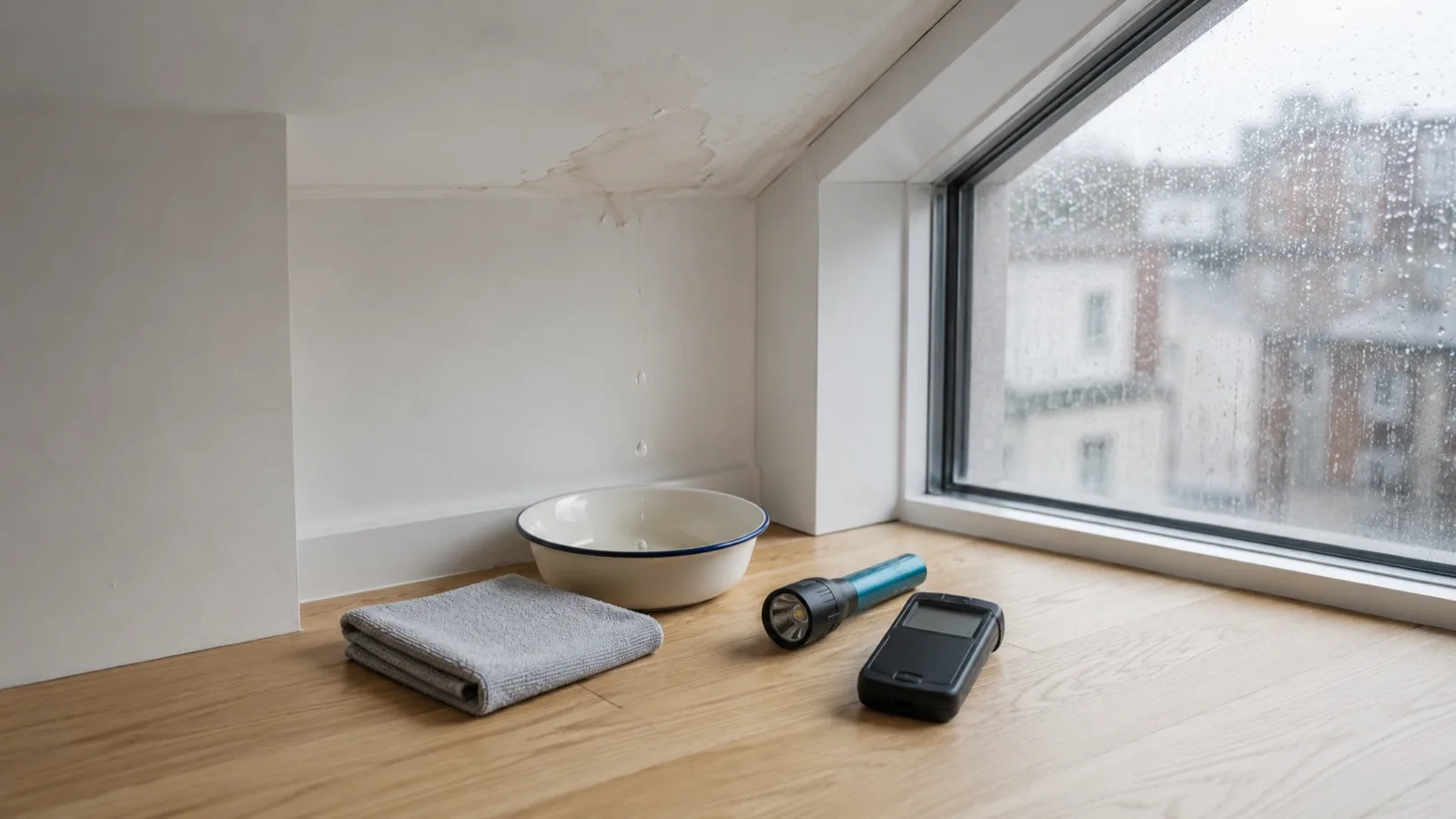
In a Dutch apartment building the owners' association (VvE) pays for a leak, survey included, when the cause sits in a communal part: the roof, the façade or the soil stack up to the branch into a flat. A cause in a private part is its owner's bill. Your deed of division draws the line (article 5:112 Civil Code).
It has been blowing a gale for two days when a stain appears on the bedroom ceiling at number 14. By eleven at night there are three photos in the VvE group chat, by half past eleven the first accusation aimed at the upstairs neighbours, and by the next morning somebody has called a roofer nobody approved. At that point the leak is the smallest of the problems. The roof, the window frames and the soil stack are listed as communal in almost every splitsingsakte, the deed of division. That puts the VvE in charge, not the owner sitting under the drip.
Communal or private: the deed decides, not the argument
The model regulations give the general line, but what governs is your own deed of division and its accompanying drawing, and that varies from block to block. So before calling a contractor, read two pages of your own deed.
The pattern you will find in most buildings:
- Roof, roof covering and rainwater drainage: communal
- Façade, foundations and load-bearing structure: communal
- Window frames and the glazing in them: communal
- The soil stack: communal, up to the branch serving each flat
- The pipework beyond that branch, floor finishes and sanitary ware: private
That last boundary is where most disputes start.
A leak in the vertical stack behind the bathroom wall is the VvE's business; the same leak half a metre further along, in the horizontal section serving only your flat, is not. Physically a small difference, financially a completely different conversation.
Who pays for finding the cause?
This is the cost that causes the most friction, and the rule is refreshingly simple: the survey follows responsibility. If the cause turns out to sit in a communal part, the VvE pays both the repair and the leak detection. If it sits in the private part, the bill goes to the owner.
Which means somebody has to fund the survey before anyone knows who will ultimately pay for it. A board that sets that policy in advance (the VvE advances the cost and recharges it if the cause proves private) avoids weeks of delay during which the water simply keeps running.
Practical note: have leak detection done by a specialist firm, not by the first contractor with a free morning. A report with thermal imaging or moisture readings is the only document that later holds up both with the insurer and with the owner who disputes the bill.
A leak from upstairs is not automatically their bill
The assumption in almost every apartment block is that whoever lives above pays for whatever gets wet below. It does not work that way. Damage caused by a defect in the building falls under the strict liability of article 6:174 of the Civil Code: the possessor of a building that falls short of reasonable standards is liable when that danger materialises, fault or no fault. If the defect sits in a communal part, the claim goes through the VvE, which can represent the owners jointly in and out of court.
If the source is something inside the upstairs flat (a washing machine hose that worked loose, a tap left running), then fault, or a defect in their own private part, is what matters. And here is the detail that surprises many owners: if the neighbours hired a contractor who botched the job, they are not automatically liable for that contractor's mistake. The Dutch rule that makes a client answer for a contractor applies only to work done for the client's business, and a private flat owner is not running one.
Living upstairs is not, by itself, a bill.
For the board this means the first question is never "who lives above", but "where is the defect". Only once that is settled do you know who to approach.
Insurance: buildings cover from the VvE, contents from the owner
The VvE usually insures the whole building under a buildings policy (opstalverzekering), which covers structural damage and, depending on the wording, internal finishes. What stands inside the flat (furniture, rugs, the laptop on the windowsill) falls under the resident's own contents insurance. Three things decide whether that cover actually pays out: the damage must be reported quickly, the cause must be established, and the rebuild value in the policy must be realistic. If the insured sum is too low, Dutch law lets the insurer cut every payout in proportion (article 7:958(5)): a building insured for 75 per cent of its value gets 15,000 euros back on a 20,000 euro claim. The same rebuild value sets the floor of the mandatory reserve fund.
What insurers rarely cover is the damage that grew because nobody acted. A leak left running for three weeks while the board waits for a quote stops being an incident and becomes negligence.
What the board does in the first 24 hours
The first day builds the file. Photograph the damage with a date, note who reported what and when, shut off the water supply where you can, and notify the insurer before the cause is known. Reporting is always allowed; cover is assessed later.
Then confirm in a single message to everyone involved what has been agreed: who commissions the survey, who advances the cost and when the next step happens. In a self-managed VvE that message is the entire file. In Vecinly the board logs the report as an incident with its photos and the agreements attached, and each owner reads the app in their own language, which helps in a block where not everyone reads Dutch; our page on international owners' associations explains how that works.
Who pays for a leak from the upstairs flat in the Netherlands?
Not automatically the upstairs neighbours. If the water comes from a communal part such as the soil stack or the roof, the VvE pays. The neighbours pay only if the cause lies in their private part and they are at fault, for example a loose washing machine hose.
Who is responsible for a water leak in an apartment?
Whoever is responsible for the part where the defect sits. The deed of division lists communal and private parts; communal defects are the VvE's, private ones the owner's, and the leak detection survey follows the same split.
What should I do if water leaks from upstairs?
Photograph the damage with the date, tell the board and the neighbours, shut off the water if you can and report it to your contents insurer straight away. The board then commissions a leak detection survey to establish where the cause sits.
A leak almost never costs as much as the atmosphere it destroys. Find the defect before you look for someone to blame, let the deed decide the cost split rather than the conversation in the hallway, and put the agreements in writing before everything dries out.
Information updated in September 2026. This article is for information only and does not constitute legal advice.
Available in 2 languages
Keep reading

Try the specialized platform for your community
Organize maintenance, communication and management easily.