Central heating in a Spanish community: who decides and who pays
No Spanish law sets the day the radiators come on. Your community does, and how it writes that decision down determines half the winter's arguments.
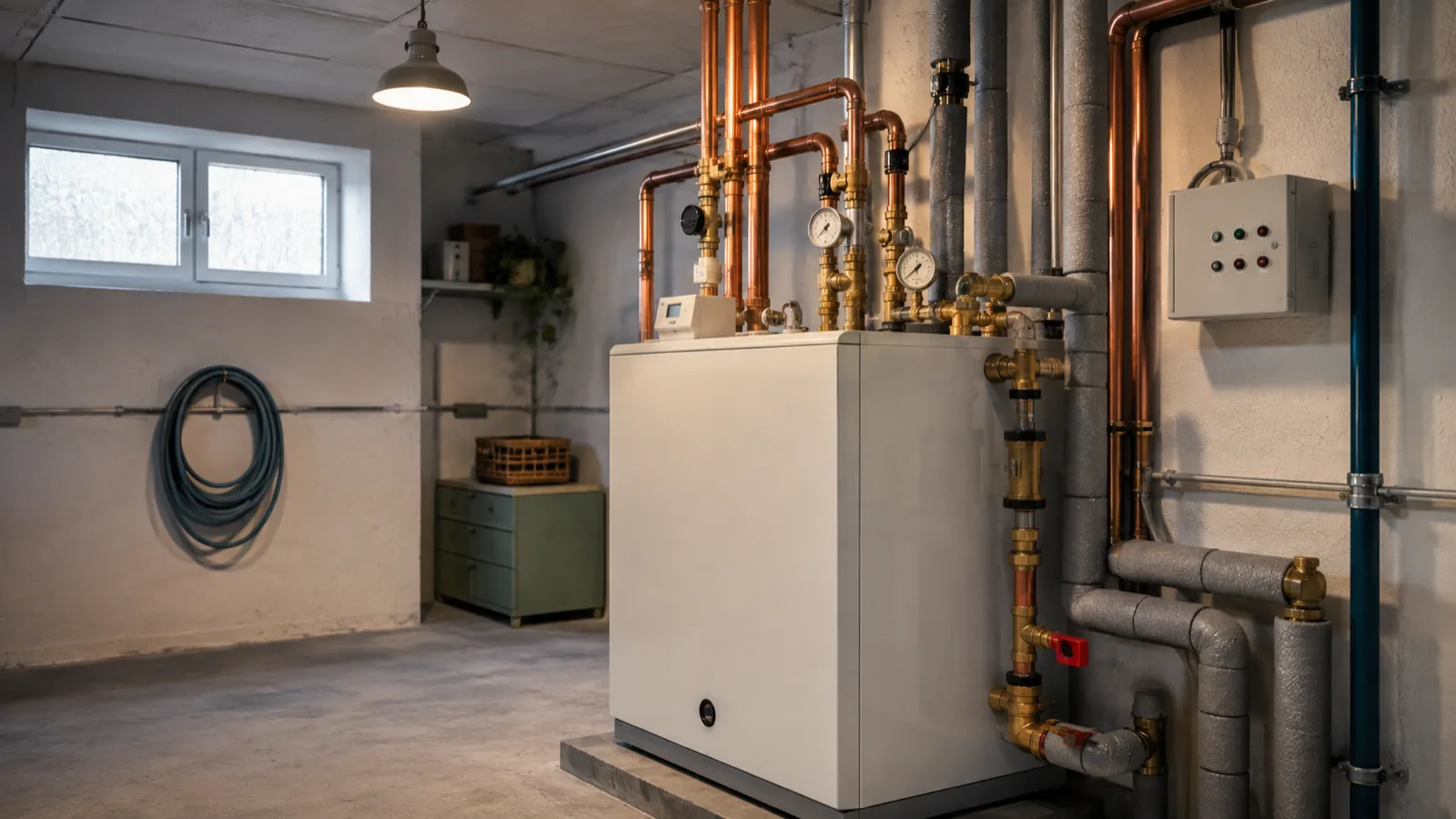
No Spanish law sets the day the radiators come on: the owners' meeting, the junta de propietarios, approves the dates, hours and temperature. What the law does fix is the split: 60 % to 75 % of the cost must follow each home's metered use, and existing meters must be read remotely before 1 January 2027 (Royal Decree 736/2020).
If you own a flat in Spain and spend part of the year elsewhere, that last date matters more than the switch-on day. You will be paying for the building's heating whether or not you are there, and the rules below decide how much.
Who decides the switch-on and the schedule
Central heating is a common service, so it runs on whatever the meeting agrees by the ordinary majority in article 17.7 of the Horizontal Property Act (LPH). If the statutes or internal rules already fix a schedule, it applies every year without a new vote; if they say nothing, it is decided season by season. A written calendar (15 October to 30 April, say) ends the argument before it starts. "That's what we always do" is no defence once somebody complains.
What holds a decision up is the written resolution.
It pays to vote on four things at once:
- The switch-on and switch-off dates for the season
- The daily time slots, weekends included
- The reference temperature in common areas and homes
- Who may order an early start during a cold snap
That last point saves the most phone calls. If the minutes let the president or administrator bring the start forward when the temperature drops, nobody has to call an extraordinary meeting in November to light a boiler. Maintenance is not optional either: a licensed maintenance company must service the installation (article 26 of the RITE), and the check belongs before the season, not on the first cold morning.
How the bill splits between fixed and variable
Under Royal Decree 736/2020, buildings with central heating must fit individual meters or heat cost allocators so each home pays for what it uses. Buildings in climate zones α, A and B are exempt, as are installations where metering is not technically feasible or cost-effective; the maintenance company certifies that second case and the community files it with the regional government.
The bill then has two parts. The variable part follows each home's readings; the fixed part is shared by participation quota. The decree puts the variable share at 60 % to 75 % of the total, which leaves a fixed share of 25 % to 40 %, with the exact figure set by the community on the maintenance company's technical advice. The fixed part pays for maintenance, common-area heating and the heat lost through risers and floor slabs, which warms the neighbour with every valve shut too. That is why an empty holiday flat still gets a heating bill all winter, and explaining it before the vote heads off a lot of disputes over the annual accounts.
Practical note: billing on actual readings must happen at least once a year. Splitting by quota alone in a building that already has allocators fitted is a resolution that can be challenged, however long "it has always been done that way".
The 2027 deadline
Allocators installed before the decree must allow remote reading, or be replaced by ones that do, before 1 January 2027. That is three months away. Regional governments inspect, and the penalties come from Law 18/2014: failing to install individual metering where it is feasible is a serious offence carrying a fine of 1,001 to 10,000 euros, and other breaches of the metering rules are minor offences at 300 to 1,000 euros (articles 80 and 82).
Ask the maintenance company three things: do the current units read remotely, can they take a radio module, or do they need replacing. If replacement was not in this year's budget, the autumn meeting will have to approve a one-off levy.
Heat pumps: one third is enough since March 2026
Royal Decree-law 7/2026 took effect on 22 March 2026 and rewrote the first paragraph of article 17.1 of the LPH. That rule already let one third of the owners holding one third of the quotas approve, at any owner's request, shared or private renewable energy systems. The old wording just said "renewable energy"; the new one adds "including aerothermal and geothermal" (RDL 7/2026, final provision 1). Parliament's ratification was published by a resolution of 26 March 2026, so the rule stands.
The catch is who pays. Under that one-third route, owners who did not expressly vote in favour cannot be charged for the installation or its upkeep; if they want to connect later, they pay their share updated with legal interest. For a whole-building boiler replacement that can leave a few owners carrying the bill. Article 17.2 offers the alternative: energy-efficiency works, or shared renewable installations, pass by a simple majority of owners and quotas and bind everyone, as long as the yearly cost per owner after grants stays within twelve months of ordinary fees.
Can an owner disconnect?
The LPH says nothing specific about disconnecting a single flat, so there is no clear-cut rule.
The money side is settled. An owner who stops using the heating still pays to maintain, repair and replace the shared boiler and risers, which remain common elements under article 9.1.e. Scrapping the service for the whole building is different: it needs the vote of three fifths of the owners holding three fifths of the quotas (article 17.3).
If you want out, bring a technical report showing the system still works for everyone else and get a resolution recording what your flat will keep paying. Closing a communal valve on your own is altering a common element, which article 7.1 of the LPH does not allow.
Do I have to pay for central heating in Spain if I don't use it?
You stop paying for consumption, but not for the fixed share (25 % to 40 % of the cost) or for maintaining the boiler and risers, which are common elements.
What majority is needed to install a heat pump in a Spanish community?
Since 22 March 2026, one third of the owners holding one third of the quotas can approve aerothermal or geothermal systems. Owners who did not vote in favour are not charged unless they later connect.
If you do one thing before the autumn meeting, ask the maintenance company whether your allocators read remotely. For owners who follow the building from abroad, we explain how a community can run without a professional administrator and what makes an online owners' meeting valid. Vecinly keeps the meeting notices, minutes and each flat's receipts in one place, readable from anywhere; see how it works for international communities.
Information updated September 2026. This article is for information only and does not constitute legal advice.
Available in 5 languages
Keep reading


Try the specialized platform for your community
Organize maintenance, communication and management easily.