Condominium fees in Portugal: how they are split and who pays
Your share comes from a number in the building's deed, not from a vote. Who pays for the lift, what a meeting can change, and what happens when you let or sell the flat.
The shop under your flat in Lisbon or Porto can own a bigger slice of the building than you do and still pay about a third of your fee. Nobody has made a mistake. Portuguese condominium fees follow two rules that pull in different directions, and the first bill rarely explains either.
The main rule: common expenses are paid in proportion to the value of each unit, a figure called the permilagem that is fixed in the building's deed (article 1424(1) of the Civil Code). The second rule carves out the costs that only some owners can benefit from, and the lift is the one written into the law by name.
The number in the deed
Every unit in a Portuguese block has a relative value, expressed in thousandths of the whole building, set out in the título constitutivo, the deed that created the horizontal property (article 1418). A flat with 120 ‰ pays 12 % of whatever is split by value, and it also carries 120 votes at the owners' meeting.
You cannot vote the number up or down. Changing it means amending the deed, and that takes the agreement of every owner, in a notarial deed or an authenticated private document (article 1419).
What the fee pays for is the upkeep and use of the common parts and the shared services: cleaning and lighting of the stairwell, the lift contract, the compulsory fire insurance, small repairs, the administrator if one is paid. On top comes at least 10 % of your share for the reserve fund (article 4 of Decree-Law 268/94), which we cover in the guide to reserve funds in European apartment buildings.
Who pays for the lift
Only the owners whose units can be served by it (article 1424(4)). The wording matters: "can be served", so a first-floor owner who always takes the stairs still pays. A street-level shop with no way into the lobby does not. The same idea applies to any common part that serves some owners exclusively: those owners pay for it, and nobody else does.
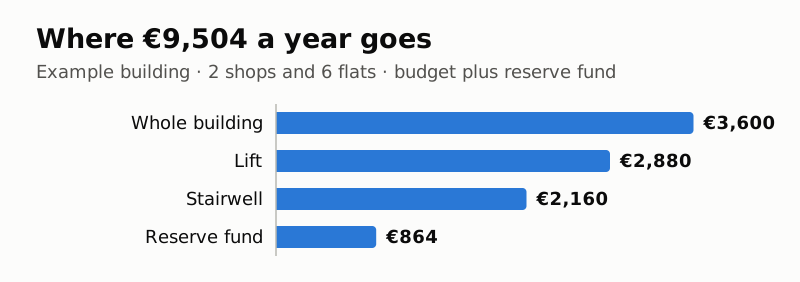
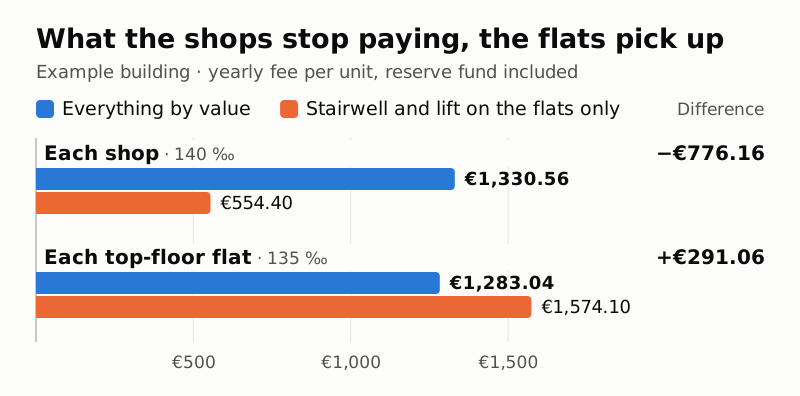
We ran the numbers on an invented building of the kind you find all over the country: two ground-floor shops at 140 ‰ each, with their own street doors, and six flats on three floors at 105, 120 and 135 ‰. The yearly budget is 8,640 euros (3,600 for the whole building, 2,160 for the stairwell, 2,880 for the lift) plus 864 for the reserve fund. Split everything by value and each shop pays 1,330.56 euros a year while a top-floor flat pays 1,283.04. Take the stairwell and the lift away from the shops, as the law does when those parts serve only the flats, and each shop drops to 554.40 euros while the top-floor flat rises to 1,574.10. The 1,552.32 euros the two shops stop paying is picked up by the six flats. That is why your bill can be higher than the one next door, and why this item gets argued over at every annual meeting.
It also explains the shop from the first paragraph.
What a meeting can change
Less than most owners assume. A clause in the building's by-laws (the regulamento) can put the cost of shared services on owners in equal parts or according to use, but it needs a majority of owners holding a majority of the building's value and it must pass without opposition (article 1424(2)). One owner voting against is enough to sink it. Before Law 8/2022 the threshold was two thirds of the value, so by-laws written before April 2022 may quote the old figure. The clause covers services such as cleaning or electricity. Repairs to the roof or the façade stay split by value unless the deed itself says otherwise.
The budget is a different matter: it is approved every year by majority vote at the January assembly. If you live abroad, send a proxy. The law lets any owner be represented.
If you let the flat or sell it
The condominium bills the owner. The minutes approving the fees are an enforceable title against the owner (article 6 of Decree-Law 268/94), whoever lives in the flat; how that plays out is in our piece on overdue condominium fees. Between landlord and tenant, the lease should say in writing who bears which charges. If it is silent, the costs of the common parts fall on the landlord (article 1078).
Selling has had its own procedure since 2022 (article 1424-A), and it comes with deadlines:
- You ask the administrator for a written statement of the unit's current charges and any debts, and the administrator has 10 days to issue it
- The statement goes into the deed of sale; a buyer who waives it accepts every debt the seller owes the condominium
- Debts stay with whoever owned the unit when they should have been paid, and anything falling due after the transfer belongs to the buyer
- You then have 15 days to notify the administrator of the sale by registered post, with the buyer's name and tax number (article 3 of Decree-Law 268/94)
In a small block the administrator is often a neighbour doing the job unpaid, with the accounts in a spreadsheet. Ask for the statement as soon as you accept an offer. Ten days is the legal limit, but it only helps if the books are up to date, and a tool such as Vecinly, which keeps each unit's charges and due dates in one place, makes that statement quick to produce (see how it works for volunteer administrators).
Are condominium fees tax-deductible in Portugal?
On the home you live in, no. On a flat you let, yes: charges that the law obliges an owner to bear, and that you have paid and can document, are deducted from rental income (article 41 of the Personal Income Tax Code). There is a catch that surprises landlords. The Tax Authority's view, set out in a 2018 ruling, is that money paid into the reserve fund is not deductible in the year you pay it. The works count later, when the fund pays for them and the administrator issues each owner a receipt for their share. Ask for a fee receipt that shows the fund contribution on a separate line.
The fee carries no VAT. A residential condominium that simply manages its common parts is not carrying on a business, according to the VAT department's circular 30111 of 2009. It pays VAT on its suppliers' invoices and cannot recover it.
Before the next meeting, ask the administrator for two documents: the deed with the permilagem table and the by-laws. If you ever take a turn running the building yourself, our guide to condominium self-management in Portugal starts where this one ends.
Information updated on 8 October 2026, with the Civil Code as amended by Law 8/2022. This article is for information only and is not legal or tax advice.
Available in 2 languages
Keep reading

Try the specialized platform for your community
Organize maintenance, communication and management easily.