Reserve funds for apartment buildings in Europe, country by country
The same 20-flat building must save 1,500 euros a year in Belgium and over 21,000 in Austria. The legal minimum reserve fund in 12 European jurisdictions, with the law behind each figure.
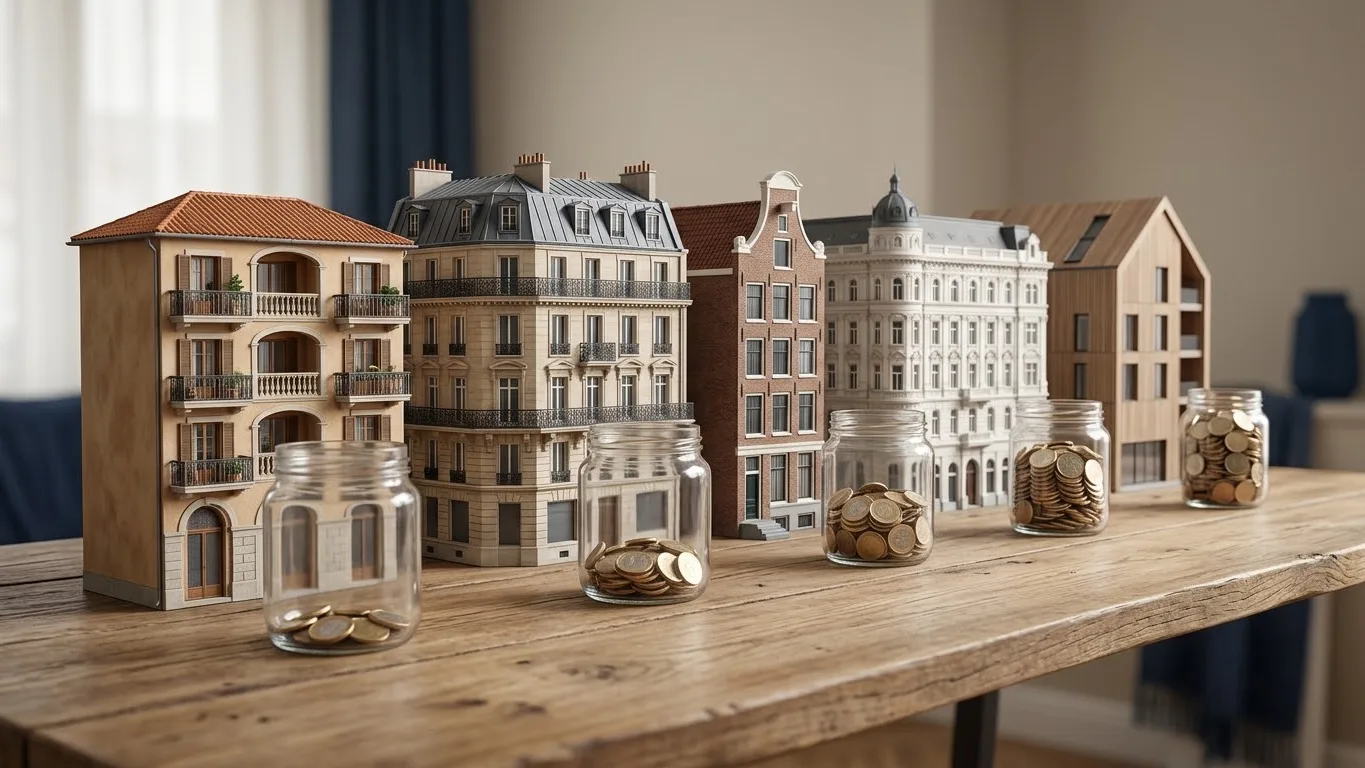
Almost every European country requires an apartment building to save for major repairs, but the minimum varies enormously. Spain, Portugal, France, Belgium, Andorra and Catalonia tie it to the yearly budget (5 or 10 %); the Netherlands and Austria tie it to the building itself, through its rebuild value or its floor area; Germany and Denmark set no figure at all; and Italy only requires the money once specific works are approved.
The result is that the same building can owe sixteen times more in one country than in another.
The legal minimum, jurisdiction by jurisdiction
| Jurisdiction | Legal minimum | What it measures | Source |
|---|---|---|---|
| Spain | Balance never below 10 % of the last ordinary budget | A floor on the fund | LPH art. 9.1.f |
| Catalonia | At least 5 % of common expenses each year; unspent money carries forward | A yearly budget line | Catalan Civil Code art. 553-6 |
| Andorra | At least 5 % of the last ordinary budget | The fund's endowment | Llei 12/2004 art. 14 |
| Portugal | At least 10 % of each owner's share of the other expenses | A yearly contribution | Decreto-Lei 268/94 art. 4 |
| France | At least 5 % of the budget; at least 2.5 % of the planned works once a multi-year works plan is adopted | A yearly contribution | service-public.gouv.fr |
| Belgium | At least 5 % of the previous year's ordinary common charges, no later than five years after the common parts are handed over; can be waived by a four-fifths vote | A yearly contribution | Civil Code art. 3.86 §3 |
| Netherlands | At least 0.5 % of the rebuild value each year, or the amount in a maintenance plan no more than five years old | A yearly contribution | Civil Code art. 5:126 |
| Austria | At least €1.12 per m² of usable area per month (2026), index-linked every two years | A monthly contribution | WEG 2002 § 31 |
| Ireland | €200 per unit per year, or another amount agreed by the members | A yearly contribution | Multi-Unit Developments Act 2011 s. 19 |
| Germany | No figure: an "adequate" reserve | Left to the owners | WEG § 19(2) no. 4 |
| Denmark | No figure; the standard bylaws require a maintenance plan approved at each ordinary general meeting | Left to the owners | Standard bylaws 2020 |
| Italy | No yearly reserve; a special fund equal to the full cost, once extraordinary works are approved | Per project | Civil Code art. 1135 |
The same building in eight countries
Take one building and move it around Europe: 20 flats, 1,600 square metres of usable area, an ordinary budget of 30,000 euros a year and a rebuild value of 4.8 million euros. The legal minimum it must put aside is:
| Where | Legal minimum |
|---|---|
| Belgium, France, Catalonia | 1,500 euros a year |
| Andorra | 1,500 euros in the fund |
| Spain | 3,000 euros in the fund at all times |
| Portugal | 3,000 euros a year |
| Ireland | 4,000 euros a year, unless the members agree otherwise |
| Austria | 21,504 euros a year |
| Netherlands | 24,000 euros a year, unless an up-to-date maintenance plan sets another amount |
The gap is not a rounding error. Countries that link the reserve to the running budget assume a building's upkeep grows with its bills; the Netherlands and Austria link it to what the building is and what rebuilding it would cost, which is closer to what a roof, a lift or a façade actually costs. A building that saves only the Belgian or French minimum for twenty years will almost certainly face a special levy the first time a large item falls due; the Dutch and Austrian minimums are designed to avoid exactly that.
Spain is the odd one out in the table: its 10 % is a minimum balance the fund must hold, not a yearly payment. Once the balance is reached and nothing is spent, Spanish law asks for nothing more that year.
Where the law sets no number
In Germany, Denmark and Italy the owners decide. German law requires an "adequate" reserve and nothing more; Danish standard bylaws require a maintenance plan but no percentage; Italian law requires the money only when works are voted, in a special fund equal to their full cost. That makes the owners' meeting, and the maintenance plan behind it, the only protection against an underfunded building.
Is a reserve fund mandatory for an apartment building in Europe?
In most European countries, yes. Spain, Portugal, France, Belgium, the Netherlands, Austria, Ireland and Andorra set a legal minimum; Germany requires an adequate reserve without a figure; Italy requires a special fund only once extraordinary works are approved.
How much should an apartment building's reserve fund be?
The legal minimums range from 5 % of the yearly budget (Belgium, France, Catalonia, Andorra) to 0.5 % of the rebuild value each year (Netherlands) and €1.12 per square metre a month (Austria). A maintenance plan listing the large items due in the next ten years is the best guide above the legal floor.
Which European countries have no minimum reserve fund?
Germany and Denmark set no figure, leaving the amount to the owners, and Italy has no yearly reserve, only a special fund once works are approved.
Every country's rules in more depth are in our national guides, for example Spain, Andorra, the Netherlands, Austria, Ireland, Germany and France. Vecinly keeps the reserve on its own line of the accounts in each of these countries, so the balance is visible to every owner.
Information updated September 2026. This article is for information only and does not constitute legal advice.
Available in 9 languages
Keep reading

Try the specialized platform for your community
Organize maintenance, communication and management easily.