Homeowners' meeting in Andorra: how to convene and hold it
In the Principality, a sound decision can be thrown out over a procedural slip. It turns on who calls the meeting, how much notice is given, who votes and what the minutes say.
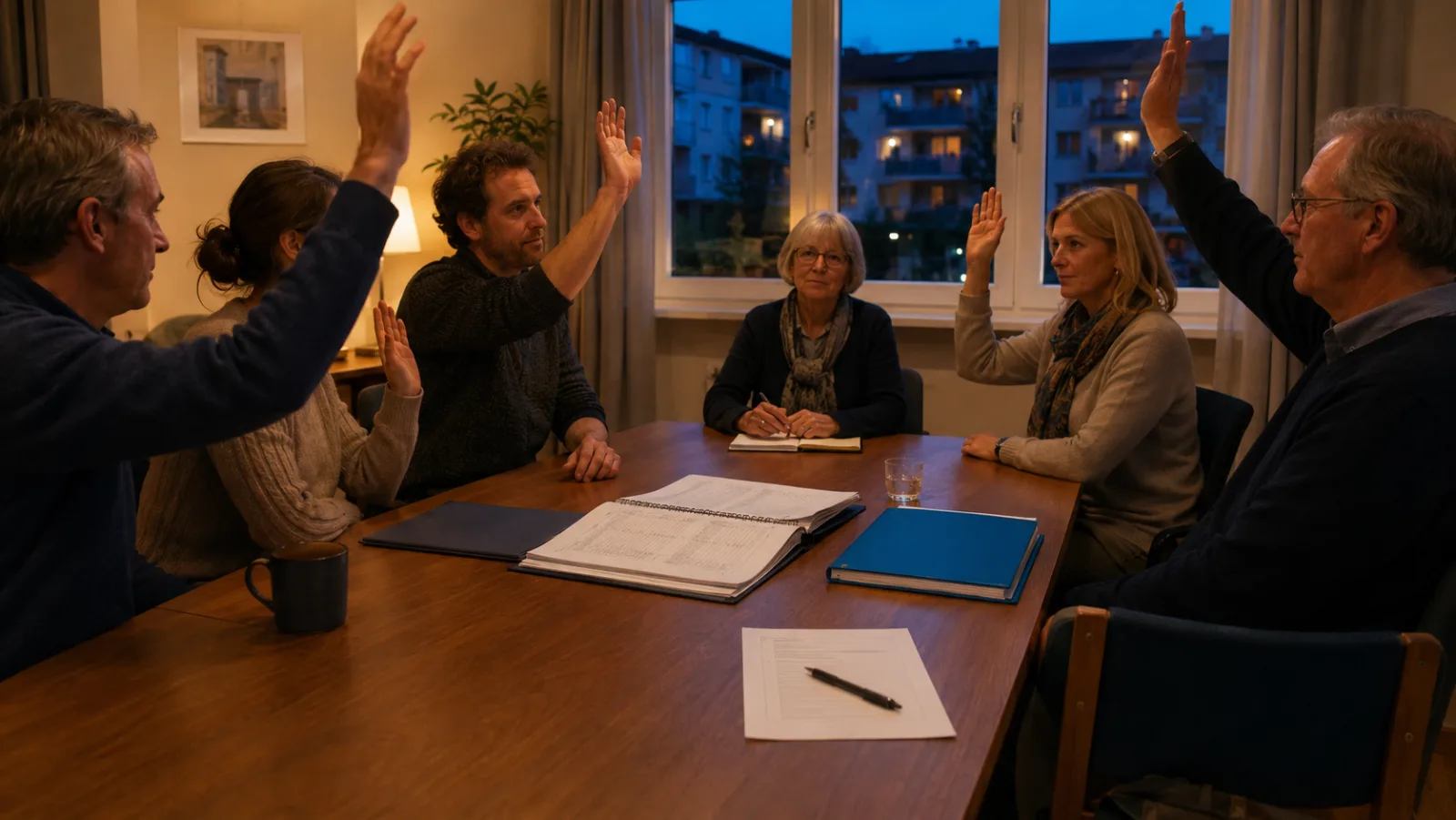
In Andorra, the annual homeowners' meeting must be called at least fifteen days in advance. At first call it needs a majority of owners who also hold a majority of the ownership shares; if that fails, the second call needs no quorum and can start thirty minutes later the same day (art. 25 of Law 12/2004).
Owners who live in the UK or elsewhere can now take part without flying in.
Andorran law, not Spanish or French
The rules come from Law 12/2004 on horizontal property, in the consolidated text published by Legislative Decree of 12 March 2018. The community has three bodies: the owners' meeting, a president chosen from among the owners, and an administrator-secretary (arts. 17 and 19). The administrator-secretary must be a member of Andorra's professional association of estate agents and property managers, unless the building has fewer than fifteen units, in which case an unpaid owner can do the job (art. 21).
Calling the meeting
The president calls it, or the administrator-secretary by delegation. A quarter of the owners, or owners holding 25% of the shares, can also demand a meeting and call it themselves if the president does not (art. 25.1 and 25.2). The notice must state the agenda and the place, date and time of the first call and, where relevant, the second; the second call only works if it was announced in the first notice (art. 25.4). Extraordinary meetings have no fixed notice period, only as much as needed for the notice to reach everyone (art. 25.5).
Since 2025, Law 5/2025 (sixth additional provision) lets communities send notices by email or electronic messaging with proof of sending and content, and hold the meeting by video link as long as every owner can access it, even if the bylaws say nothing about it. The administrator-secretary checks participants' identity beforehand, and the minutes are signed by the administrator-secretary and the president. If you own from abroad, register an email address with the administrator in writing; where paper notices go otherwise is covered in our guide to reserve funds and notifications.
Majorities
| Decision | Majority required | Article |
|---|---|---|
| Ordinary business, first call | Majority of all owners holding a majority of shares | 28.1 |
| Ordinary business, second call | Majority of those present holding over half of the shares present | 28.2 |
| Creating or removing shared services (lift, concierge, heating) or leasing common areas | 3/5 of owners and 3/5 of shares | 26.2 |
| Removing architectural barriers | Majority of owners and of shares | 26.3 |
| Telecoms or collective energy supply infrastructure | Absolute majority of shares | 27 |
| Amending the deed of division or the bylaws | 3/4 of owners and 3/4 of shares | 26.1 |
| Redistributing shares or granting exclusive use of a common element | Unanimity | 26.1 |
The bylaws row changed in 2008: Law 25/2008 replaced unanimity with three quarters and kept unanimity only for share changes and exclusive use of common elements. Two further rules matter to owners who stay away. For article 26 decisions, a properly summoned absent owner who does not object in writing within thirty calendar days of being notified is counted as voting in favour (art. 26.4). And an owner with unpaid, unchallenged arrears may speak but not vote, and neither they nor their share count towards any majority (art. 24.6). Each owner can hold written proxies for up to six others (art. 24.1).
Minutes
Resolutions go into a numbered minute book signed by the president and the administrator-secretary, and the minutes must record, among other things, who attended or was represented with their shares and how each owner voted (art. 29). They are signed at the end of the meeting or within ten days, become enforceable once closed, and a copy goes to every owner (art. 29.3).
How much notice is needed for a homeowners' meeting in Andorra?
At least fifteen days for the annual meeting. Extraordinary meetings need as much notice as possible for it to reach every owner (art. 25.5 of Law 12/2004).
Can I attend an Andorran owners' meeting online?
Yes, since Law 5/2025, provided every owner can access the video link and the administrator-secretary verifies identities first. It applies even if the bylaws do not mention it.
What majority is needed to change the bylaws?
Three quarters of the owners holding three quarters of the shares. Unanimity is only required to redistribute shares or give one unit exclusive use of a common element.
If you own from abroad, give your proxy in writing or ask for the video link before the notice period starts. If the meeting is about to approve a renovation, see how Pla Renova grants for communities are paid first. In small buildings where an owner acts as administrator-secretary, Vecinly keeps notices, minutes and ownership shares in one place; see our community management software.
Information updated September 2026. This article is for informational purposes only and does not constitute legal advice.
Available in 4 languages
Keep reading


Try the specialized platform for your community
Organize maintenance, communication and management easily.