Millesimal tables in an Italian condominium, explained
Every flat's value out of 1,000 decides what you pay and how much your vote weighs. Renovating your kitchen does not change it. How the tables are worked out, approved and corrected.
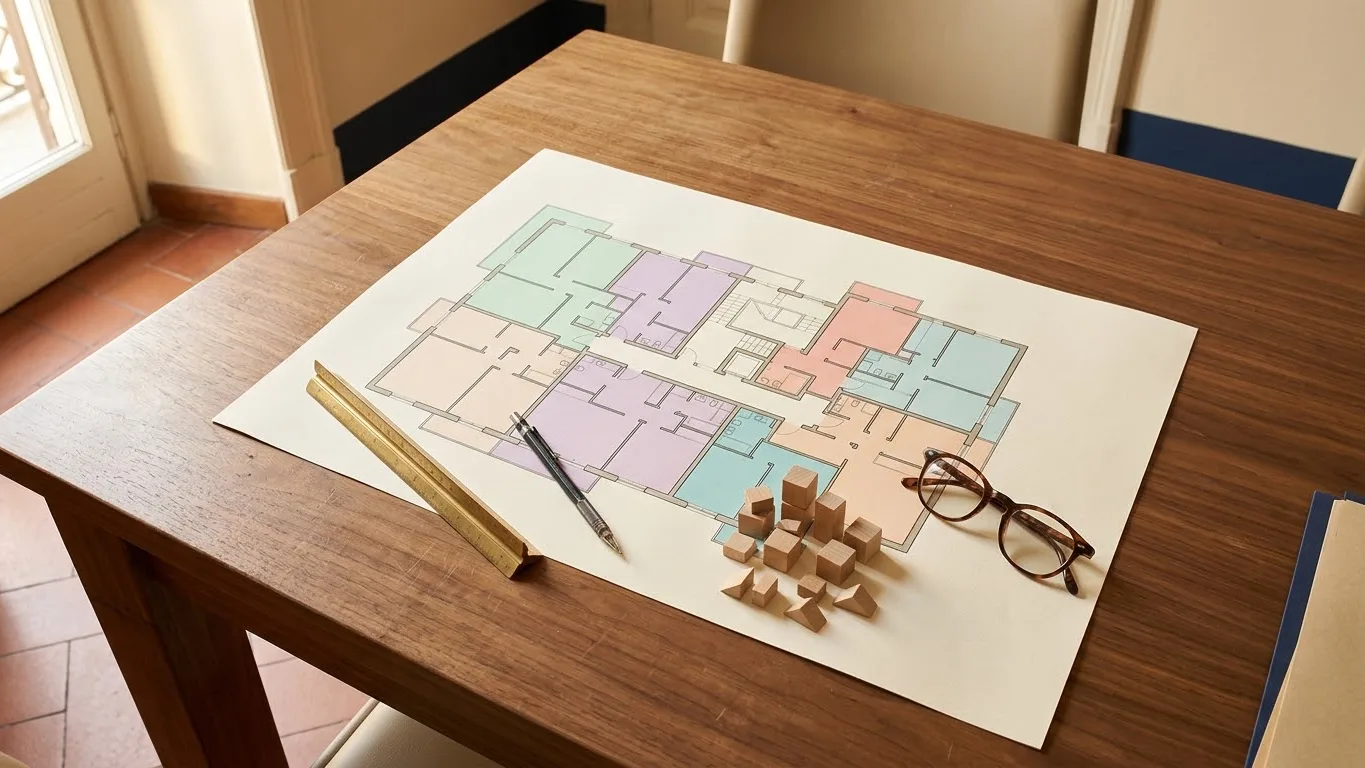
Italian tabelle millesimali express the value of each unit in a condominium in thousandths, out of a total of 1,000, and they drive two things: how shared costs are split and how much each owner's vote weighs at the assembly. By law they ignore rent, improvements and the state of repair of each unit (article 68 of the implementing provisions of the civil code).
Owners who bought a renovated flat in Tuscany often expect a higher share. They do not get one.
How they are worked out
The law sets the principle, not the formula. In practice a surveyor turns each unit's floor area into a "virtual" area using coefficients for floor level, orientation, light and use (home, shop, garage), then divides each unit's virtual area by the total and multiplies by 1,000. Four flats with virtual areas of 80, 95, 110 and 115 square metres, 400 in all, come to 200, 237.5, 275 and 287.5 thousandths. Costs follow those figures under article 1123 of the civil code, except for things used to different degrees, such as stairs and lifts, which usually have their own tables: the top floor pays more for the lift than the ground floor.
Approving, changing and correcting them
| What | Majority | Source |
|---|---|---|
| Approving the tables | Majority of those present holding at least 500 thousandths | Court of Cassation, joint chambers, no. 18477 of 2010 |
| Changing them by choice | Unanimity | Art. 69 of the implementing provisions |
| Correcting an error | Majority of those present holding at least 500 thousandths, even at one owner's request | Art. 69 |
| Correcting a value that has moved by more than a fifth | As above; whoever caused the change pays for the revision | Art. 69 |
Article 69 is the rule to know if you think your share is wrong. Changing the criteria needs everyone's agreement, but correcting an error needs only the ordinary qualified majority, and a single owner can ask for it. The same applies when a raised storey, an extension or a split of units shifts any unit's value by more than a fifth; in that case the owner who caused the change pays for the new calculation. A claim over the tables can only be brought against the condominium itself, through its administrator, who must tell the assembly straight away.
A building with no tables
Above ten owners, the building must have a set of rules (regolamento), and the tables are attached to it. A small building may never have had them and splits costs per flat instead. That holds until the first large bill, such as a new roof, when the split becomes the argument.
Have a surveyor draw them up before the next big expense, not during it.
The tables also matter when you vote. Assembly majorities count heads and thousandths together, so the owner of a large flat carries more weight in a close vote than the owner of a studio, even though both count as one head.
Ask the administrator for the tables before your first assembly, and check that your unit's figure matches the regulation attached to your deed. If it does not, the correction route above costs a vote, not a court case. For the numbers behind each majority at the assembly itself, see our guide to condominium assembly majorities under article 1136, and if the building is small enough to run without a professional, the rules are in a condominium without an administrator.
Information updated September 2026. This article is for information only and does not constitute legal advice.
Available in 2 languages
Keep reading


Try the specialized platform for your community
Organize maintenance, communication and management easily.