Who pays what in an Italian condominio: the expense rules
Millesimi shares, stairs and lifts, roof terraces, tenants and new owners: how Italian law splits condominium expenses — and why the ground floor pays for the lift after all.
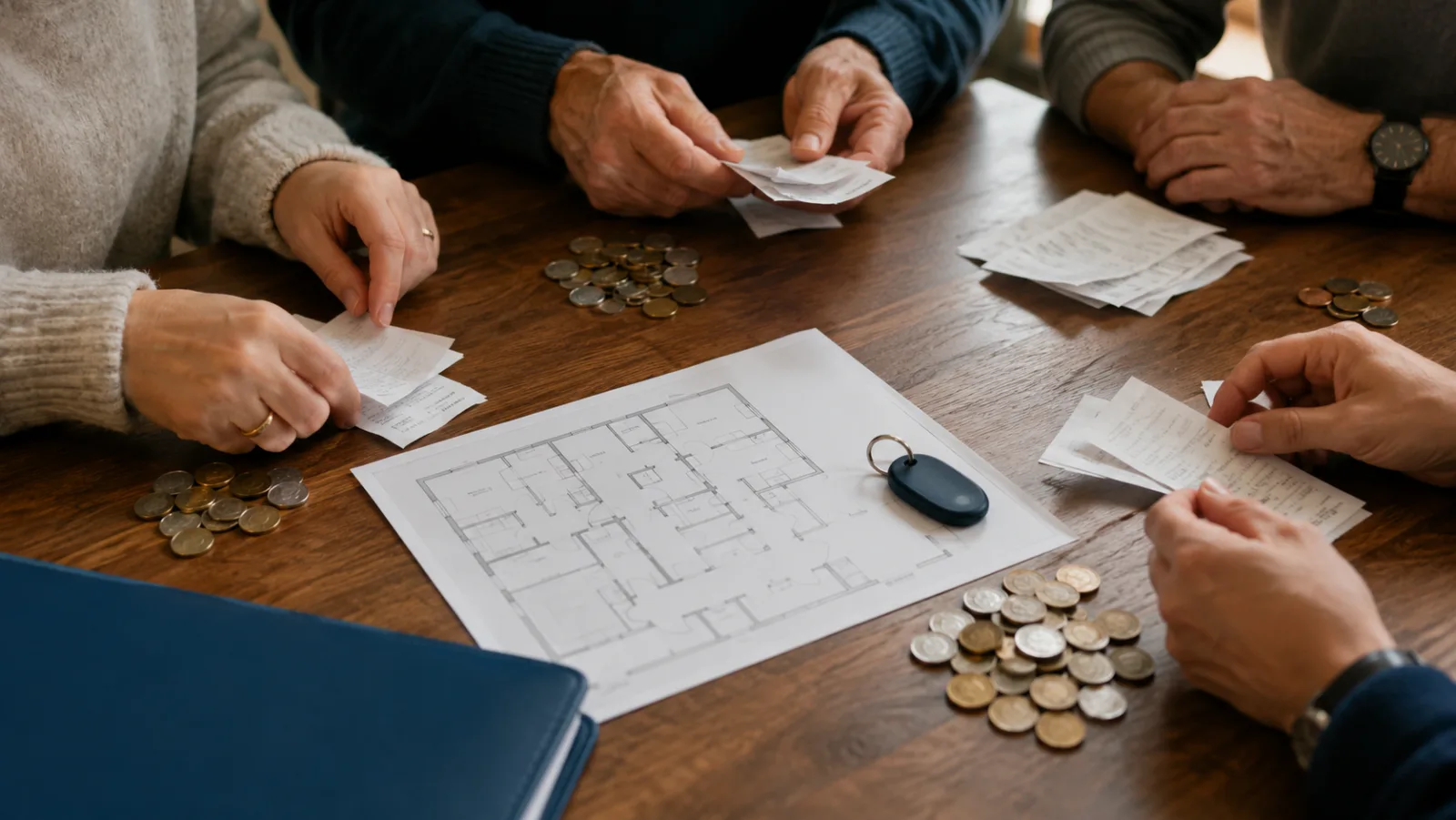
In an Italian condominium, shared costs are split by each owner's millesimi, their share of the building's value (Article 1123 of the Civil Code). Stairs and lifts are paid half by millesimi and half by floor height (Article 1124); a private roof terrace, one third by its user and two thirds by the flats below (Article 1126).
Half past nine in the evening, the meeting room on the ground floor, item four on the agenda: replacing the lift. The ground-floor owner has already raised his hand (he never sets foot in the thing, so why should he pay?) and the owner of the penthouse fires back that without a lift the whole building loses value. It is the oldest argument in any Italian apartment block, and the Civil Code settled it long ago with the double criterion of Article 1124. The ground floor pays, but pays little; the penthouse pays the most because it climbs the furthest.
The lift is only the most famous quarrel, though. Working out who pays what in an Italian condominio comes down to a handful of provisions (Articles 1123, 1124 and 1126 of the Civil Code, plus the tenancy law when the flat is rented out) and knowing them before the meeting defuses half the arguments. Everything below reflects Italian law; other countries slice these costs quite differently.
How are expenses divided by millesimi?
The general rule sits in Article 1123: the costs of preserving and enjoying the common parts, of shared services and of improvements approved by the majority are borne in proportion to the value of each owner's property. That value is expressed by the tabelle millesimali attached to the building's regulations: an owner holding 25 millesimi out of a thousand pays 2.5 per cent of every general expense, from repainting the facade to insuring the building. The proportion applies unless there is a different agreement, and the word matters. Departing from the legal criterion requires the consent of every owner, in writing or by unanimous vote. A majority, however large, cannot decide that someone will pay more or less than the law assigns them (the voting thresholds for each kind of decision are in assembly majorities in Italy).
Article 1123 then adds two common-sense correctives.
Where a common element serves the owners to different degrees, costs are shared in proportion to the use each can make of it. And where an installation serves only some of them (staircase B, the courtyard of one wing) the related costs fall solely on the group that benefits.
Does the ground floor pay for the lift?
Yes, and not out of legislative cruelty. Article 1124 imposes the double criterion from the opening scene (half by millesimi, half by height from the ground) on the maintenance and replacement of stairs and lifts, and for the half split by value, privately owned attics and terraces count as floors too. The reason even the lowest flats contribute is that stairs and lifts do not serve the apartments alone: they lead to the roof, the terraces and the technical rooms, common parts for which every owner answers in proportion to their share.
The height corrective does the rest: in the half calculated by floors, the ground floor weighs almost nothing and the top floor weighs the most. It is the Code's way of turning presumed use into numbers without measuring anyone's actual journeys.
Legal note: the double criterion covers the upkeep and replacement of an existing installation. Fitting a lift where none existed is an improvement and follows different rules: it is apportioned under Article 1123, and owners who do not wish to benefit may stay out of it when the cost is very heavy and the lift can be used separately (Article 1121).
How are roof terrace costs shared?
The lastrico solare is the case where a single surface is one person's floor and everyone else's roof. When its use is not common to all, Article 1126 cuts the expense cleanly: whoever has exclusive use contributes one third of the cost of repairs or rebuilding; the remaining two thirds fall on the owners of the building (or the part of it) that the terrace covers, in proportion to the value of their units.
The logic mirrors the lift: the person walking on the terrace wears it down, the people below receive its shelter. Experienced administrators check one thing before apportioning: which units the terrace actually covers. Flats outside its vertical projection stay out of the two-thirds share, and that detail is where most of the litigation starts.
Extraordinary expenses: owner or tenant?
When the flat is rented out, Law 392/1978 comes into play: its Article 9 lists the oneri accessori, the service charges the tenant must bear. The underlying test is simple: the tenant pays for what they consume and the services they enjoy day by day, while the owner pays for whatever preserves the value of the property over time.
Unless the contract says otherwise, the tenant therefore covers:
- Cleaning of the common parts and drainage of cesspits
- The running and ordinary maintenance of the lift
- Water, electricity for the common areas, heating and air conditioning
- The porter service, up to 90 per cent of its cost
Everything else (redoing the roof, replacing the heating plant, structural work on the facade) is an extraordinary expense and belongs to the owner. A habit that saves landlords grief: ask the administrator for accounts that separate ordinary from extraordinary items, because forwarding the tenant a single lump sum is the fastest way to argue about it twice. The tenant is entitled to a breakdown with the allocation criteria before paying, and then has two months from the request to settle.
Legal note: towards the condominium, the owner is always the one who answers. The split with the tenant operates only inside the tenancy relationship: the administrator bills the registered owner, who then recovers the tenant's share under the lease.
Does a new owner answer for the seller's debts?
Yes, within a precise limit. Article 63 of the implementing provisions of the Civil Code makes whoever takes over a unit jointly and severally liable with the seller for the charges of the current year and the previous one. The seller, for their part, stays liable alongside the buyer until the administrator receives a certified copy of the deed.
In practice the administrator can claim those instalments directly from the new owner, including through a decreto ingiuntivo, the fast-track payment order explained in injunction orders and Article 63, and the buyer must then recover from the seller whatever was never theirs to pay. That is why, before completion, it always pays to obtain the administrator's certificate on the state of payments, which the administrator must issue on request (Article 1130, point 9): it is the document that tells you how much debt you are buying along with the keys.
Most of these arguments start with a split nobody saw before the meeting. Vecinly divides each expense by millesimi and shows every owner their own share; if you own in Italy from abroad, the page on international communities explains how it works across languages.
Who pays condo fees when renting in Italy?
Unless the lease says otherwise, the tenant pays cleaning, lift running and routine maintenance, water, common-area electricity, heating and 90 per cent of the porter service (Article 9 of Law 392/1978). Extraordinary works stay with the owner, who answers to the condominium for everything.
Who pays unpaid condo fees when a flat in Italy is sold?
The buyer is jointly liable with the seller for the current and the previous year's charges (Article 63 of the implementing provisions). Ask the administrator for the payment-status certificate before completion.
Shares as the rule, actual use as the corrective, unanimity to change the deal: the way Italy splits condominium expenses is far less arbitrary than it feels at the end of a long meeting. Owners who arrive knowing which criterion governs their case (1123, 1124 or 1126) argue about figures rather than principles. And that is almost always a shorter argument.
Information current as of September 2026. This article is for information purposes only and does not constitute legal advice.
Available in 2 languages
Keep reading

Try the specialized platform for your community
Organize maintenance, communication and management easily.