AGM rules for an owners' management company: notice, quorum, proxies
Two Acts govern the same meeting and they count the days differently. The countback for a real date, what goes in the envelope and what happens when four people turn up.

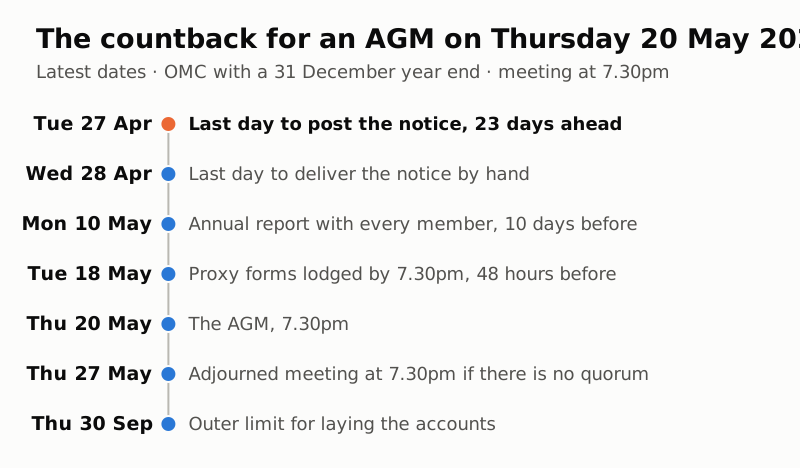
Every OMC director knows the AGM needs 21 days' notice. Post the notice exactly three weeks before the meeting and it is two days late. The Companies Act 2014 counts 21 clear days: the day the notice is served and the day of the meeting are both left out, and a posted notice only counts as served 24 hours after it goes in the postbox (section 181). For a Thursday meeting the envelopes go out on a Tuesday, 23 days ahead.
The annual general meeting of an owners' management company answers to two statutes at once, and only one of them tells you how to count. Below is the countback we ran for a real date, what has to travel with the notice, and what the law does when four people turn up in a block of forty.
Two Acts, one evening
An OMC is a company, nearly always one limited by guarantee, so the Companies Act applies in full: an AGM in every calendar year with no more than 15 months between one and the next (section 175), no option of replacing it with a written resolution once there is more than one member (section 1202), and financial statements laid before the members within nine months of the year end (section 341), which for a 31 December year end means 30 September. On top of that sits the Multi-Unit Developments Act 2011. Its section 17 requires a meeting at least once a year to consider an annual report, 21 days' notice to each member, the report in members' hands at least 10 days beforehand, and a venue within reasonable proximity to the development at a reasonable time unless 75 per cent of members agree otherwise in writing. Subsection (6) removes any doubt about which Act wins: the MUD obligations are in addition to every other duty the company has.
Where they differ, take the stricter rule.
One evening can satisfy both, and most boards add a third item. The annual service charge cannot be levied until a general meeting has considered the budget estimate (section 18), so the AGM is where next year's figure usually goes to the floor. How that vote works is covered in our piece on service charges.
The countback for a Thursday in May
We ran the dates for an OMC with a 31 December year end that wants its AGM on Thursday 20 May 2027 at 7.30pm. This is our own count from the sections cited, checked against the consolidated text in October 2026, and it assumes the constitution does not ask for longer notice (it can).
| Step | Latest date | Rule |
|---|---|---|
| Notice posted | Tuesday 27 April | 21 clear days plus 24 hours in the post, s.181 |
| Notice delivered by hand | Wednesday 28 April | 21 clear days, s.181 |
| Annual report with every member | Monday 10 May | 10 days before, MUD Act s.17 |
| Proxy forms lodged | Tuesday 18 May, 7.30pm | 48 hours before, s.183 |
| Adjourned meeting if no quorum | Thursday 27 May, 7.30pm | Same day next week, s.182 |
| Outer limit for laying the accounts | 30 September 2027 | Nine months from year end, s.341 |
Count 21 days back from 20 May and you land on Thursday 29 April, the same weekday three weeks earlier, which is how the date usually gets picked. Post that day and the notice is deemed given on Friday 30 April. That leaves 19 clear days.
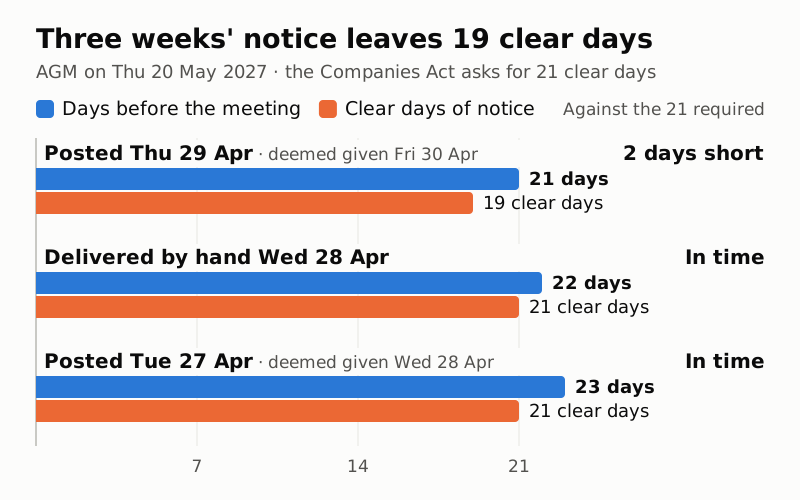
Short notice can be cured, but only if every member entitled to attend and vote agrees, along with the auditors where the company has them. In a block of forty that is forty signatures. The Act does forgive the accidental failure to notify one person, unless the constitution says otherwise, which protects you from the envelope that went astray. It does nothing for a notice that reached everybody late.
The MUD Act says the report must arrive "at least 10 days before" and gives no counting rule of its own. Our practice is to put the report in the same envelope as the notice: one posting, one date to prove.
Note: e-mail only counts as service where the constitution permits it or the member has consented in writing to that means (section 218). An address collected years ago for gate fobs is not, on its own, that consent. Until you hold it for every member, post the notice and treat the e-mail as a courtesy copy.
What has to be in the envelope
The notice itself must give the date, the time and the place of the meeting, the general nature of the business, the text or substance of any special resolution, and a reasonably prominent statement that a member may appoint a proxy, that the proxy need not be a member, and the deadline for lodging the form. If any part of the meeting is online it must also name the platform and explain access and voting.
The annual report is the document boards underestimate. Section 17 lists what it must contain, and most of it is not accounting:
- A statement of income and expenditure and a statement of assets and liabilities
- The sinking fund balance, the annual contribution and how it is calculated
- The service charge for the period and the projected charge for the current one
- Planned non-recurring spending on refurbishment, improvement or maintenance
- The insured value of the development, the premium, the insurer and the main risks covered
- The fire safety equipment installed and how it is maintained
- Any contract between the OMC and a director, or a person connected to one
Your accountant's financial statements cover the first line. The rest somebody on the board has to write, and the sinking fund line is the one members read first, for the reasons set out in why €200 per unit falls short. Software such as Vecinly sends the notice and the agenda to each owner's phone and keeps the minutes afterwards (features); it runs alongside the posted notice until every member has consented to electronic service.
What happens if there is no quorum at the AGM?
By default two members, present in person or by proxy, are enough (section 182). The constitution can set a different number and, where it does, its number is the one that counts. Read it before you book the room.
If the quorum is missing 15 minutes after the appointed time, the meeting stands adjourned to the same day the following week at the same time and place, or to whatever the directors fix. If the adjourned meeting is still short after half an hour, the members who are there form the quorum. Both steps are defaults that the constitution can change.
Proxies are the cheap fix, because they count towards the quorum. Any member can appoint anyone, a member or otherwise, and the form must reach the company 48 hours before the meeting at the latest, by post or electronically; the constitution can shorten that deadline but not lengthen it (section 183). A form that arrives late is invalid. The MUD Act attaches one vote to each residential unit (sections 14 and 15) and, unless the constitution provides otherwise, a member with money immediately payable to the company cannot vote (section 1206). Any objection to a voter has to be raised at the meeting itself and the chair's ruling is final, so the arrears list belongs on the chair's table.
Can an OMC hold its AGM online?
Company law says yes. Since 3 December 2024 a company need not use a physical venue and may meet wholly or partly by electronic means, unless its constitution says otherwise, provided everyone entitled to attend has a reasonable opportunity to take part (section 176A). People who join that way count as present.
The MUD Act still requires the annual meeting to take place within reasonable proximity to the development. That subsection has not been amended, and it does not say whether a video link qualifies. Our view: run it hybrid, with a room near the block and a link for everyone else. You get the turnout without becoming the board that tests the point.
Skip a year and a member can go over the board's head
Failing to hold the AGM is a category 3 offence for the company and for any officer in default. Any member may also apply to the Corporate Enforcement Authority, which can call the meeting itself and even direct that one member present constitutes a meeting (section 175).
Members do not have to wait for a default. Those holding 10 per cent of the voting rights can requisition an extraordinary general meeting; the directors then have 21 days to convene it for a date within two months, failing which the requisitionists may call it themselves at the company's expense (section 1203, adapting section 178). In a 30-unit block that is three owners. An EGM needs seven days' notice, or 21 if a special resolution is proposed.
Holding the meeting does not file anything. The annual return is a separate obligation, due within 56 days of the company's annual return date (section 343). Boards weighing up whether to run all this without an agent will find a readiness test in our guide to changing the managing agent.
Does a management company have to hold an AGM?
Yes. An OMC with more than one member must hold an AGM every calendar year, no more than 15 months apart, and cannot replace it with a written resolution. The MUD Act separately requires a yearly meeting to consider the annual report.
How much notice is needed for an AGM?
At least 21 clear days, not counting the day of service or the day of the meeting. Posted notices are deemed served 24 hours after posting, so post 23 days ahead. The constitution may require more.
What happens if there is no quorum at an AGM?
Unless the constitution says otherwise, the meeting is adjourned to the same day the following week. If there is still no quorum half an hour after the start time, the members present form the quorum.
Can a tenant attend an AGM?
Not as of right: notice goes to the members and to the company's directors and secretary. But a proxy need not be a member, so an owner can appoint the tenant as proxy, and the tenant may then speak and vote.
Once the meeting is over, write the minutes into the company's books straight away and have the chair sign them. Signed minutes are evidence of what happened and, until someone proves the contrary, the meeting is deemed duly convened and held (section 199). Before you pick next year's date, open the constitution and find its notice period, its quorum and its proxy deadline. Then count back 23 days.
Information updated in October 2026. This article is for information only and does not constitute legal advice.
Keep reading


Try the specialized platform for your community
Organize maintenance, communication and management easily.