VvE contribution in the Netherlands: what it covers, who pays
Your monthly VvE bill follows a fraction in the building's deed, not a vote. What it covers, why the ground floor pays for the lift, and what changes if you let, buy or sell.
The figure that sets your monthly bill in a Dutch apartment building is a fraction in a notarial deed, written in Dutch, that most foreign buyers sign for without reading. It is called the breukdeel. The VvE contribution (VvE-bijdrage, often advertised as servicekosten) is split in the ratio laid down in the building's regulations, usually those fractions. Where the regulations say nothing, every apartment pays an equal share (article 5:113(2) of the Dutch Civil Code). The owners' meeting decides the budget each year. Changing the split means amending the deed, which takes every owner or a decision carried by four fifths of all votes (article 5:139).
So the meeting controls the total, and the deed controls your slice of it.
What you are paying for
Membership of the owners' association (the VvE) is automatic for every apartment owner and ends only when you stop being one (article 5:125). The statutes must provide for contributions owed periodically, at least once a year (article 5:112), and most associations collect monthly.
The money goes two ways. One part pays the running costs: the building insurance, cleaning and lighting of the stairwell, the lift contract, bank charges and sometimes a managing agent. The other part is saving. Dutch law obliges the association to keep a reserve fund for costs beyond the ordinary yearly ones, with a legal minimum explained in our article on the mandatory VvE reserve fund. A low contribution is therefore no bargain if it means the roof has not been saved for.
Does the ground floor pay for the lift?
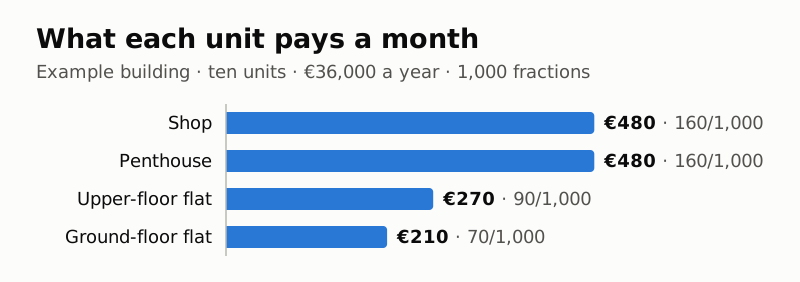
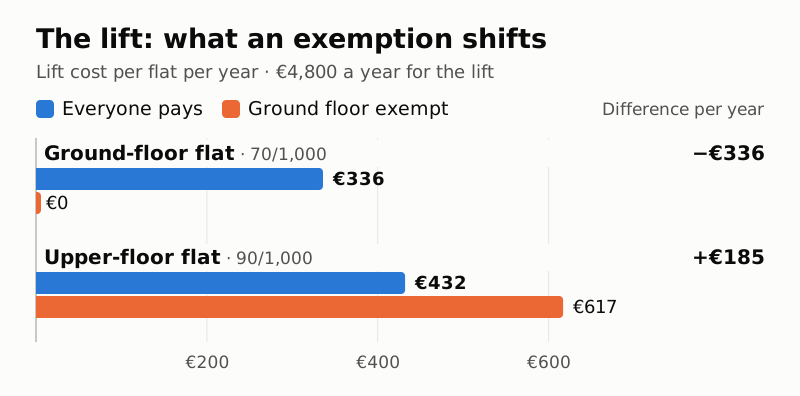
Yes, unless the deed says otherwise. The Civil Code contains no exemption for owners who do not use a facility; it points to the ratio in the regulations and stops there. To see what that means in euros, we worked through an invented but typical building: ten units, a lift and a yearly budget of 36,000 euros, of which 4,800 euros is for the lift. The fractions add up to 1,000. A ground-floor flat holding 70 of them pays 210 euros a month, an upper-floor flat with 90 pays 270, and the penthouse and the shop, with 160 each, pay 480. Exempting the shop and the two ground-floor flats from the lift would save a ground-floor flat 28 euros a month and push each upper-floor flat from 432 to 617 euros a year for the lift alone. Three owners gain and seven lose. If each unit has one vote (check, because the statutes fix the number of votes), the change needs eight of the ten, so five of the seven owners who would pay more have to support it.
The vote is only the first hurdle. Every bank holding a mortgage on one of the flats has to consent to the amendment, a notary has to draw up and register it, and an owner who did not vote in favour has three months to ask a court to annul the decision (article 5:140b). In practice the split you buy into is the split you keep.
If you let the flat out
The association has no contract with your tenant. Three points matter before you draft the lease:
- The contribution is owed by the owner, wherever the owner lives, so arrears land on you even if the lease passes part of the cost on
- What you may charge a residential tenant is called service charges in tenancy law, and you owe the tenant an itemised statement every year, within six months of the end of the calendar year (article 7:259)
- For residential leases signed from 1 January 2027, service charges are limited to the items listed in the Service Charges Decree, such as energy and water for the shared areas, minor repairs and waste collection
The reserve fund, the building insurance and the association's management costs are not on that list. Leases signed before that date stay under the old rules (Stb. 2025, 156). Either way you need the association's accounts broken down by type of cost, so ask the board for them early in the year. Boards that keep the budget by cost group, in a spreadsheet or in a tool such as Vecinly, can produce that per flat without extra work; see Vecinly for board members.
When you buy or sell, and at tax time
When a flat is sold, buyer and seller are jointly liable for contributions that fell due, or will fall due, in the current and the previous financial year (article 5:122), unless the regulations divide it differently. The notary attaches a statement from the board to the transfer deed. It shows what the seller owes on the day of transfer, the size of the reserve fund and the association's debts, and as a buyer you are not liable to the association beyond the amount it states. Read it before completion: a thin reserve fund in an old building tells you more about future bills than the monthly figure in the listing. After the transfer you must notify the association in writing without delay.
For your own home, the contribution is not deductible. The Income Tax Act limits deductible housing costs to mortgage interest, financing costs and ground rent (article 3.120). Your share of the association's assets does belong on the return: it counts as a bank balance in box 3 (article 5.2(3)), measured on 1 January. The board can tell you the amount.
Before you sign for a flat, ask for three documents: the deed of division with the model regulations it refers to, the current budget and the latest annual accounts. If the building runs itself without a manager, our guide to self-managing a small VvE explains who keeps them. An English summary from the agent is a courtesy; the Dutch deed is what binds you.
Information updated October 2026, based on Book 5 of the Dutch Civil Code as in force and the service charge rules taking effect on 1 January 2027. This article is for information only and does not constitute legal or tax advice.
Available in 2 languages
Keep reading

Try the specialized platform for your community
Organize maintenance, communication and management easily.