Community fees in Andorra: what they cover and who pays them
In Andorra your share comes from the building's deed, which may carry two coefficients. What the fee covers, how the split can change, and who gets the bill when a flat is let or sold.

Your lease says the tenant pays the community fees. So who gets chased when the tenant stops paying?
You do. Under Andorran law the duty to contribute to common expenses lies exclusively with the owner, even where the tenancy contract shifts it to the tenant (art. 13.3 of Law 12/2004). How much you owe depends on the ownership share set in the building's deed of division, the títol constitutiu. Andorra has its own condominium statute, and the text in force is the consolidated version published in 2018. Spanish and Catalan rules stop at the border.
What community fees mean here
The statute gives no list. It refers to general expenses for the upkeep of the building and its services that cannot be attributed to one unit, so anything with its own meter is paid by whoever uses it. Three items must be in every budget (art. 14):
- Insurance covering damage to third parties and to the building
- A permanent maintenance contract for the building and its general installations
- The reserve fund contribution, explained in our guide to the reserve fund and notifications
The owners' meeting decides whether you are billed monthly or quarterly (art. 33).
One flat, possibly two coefficients
The deed gives each unit an ownership coefficient in hundredths, based on usable floor area, whether the unit faces inwards or outwards, its position and the use it is presumed to make of shared services. Article 3.3 then adds a sentence most owners have never read: where the two differ, the deed must also set a coefficient for sharing community expenses. Votes are counted with the first and bills are calculated with the second. We ran the numbers on a made-up building to show the gap. It has six flats at 9% each, two penthouses at 13% and a street-level shop at 20%, with an ordinary budget of €24,000 a year, of which €3,600 is the lift and €2,400 is stair cleaning. Split purely by share, the shop pays €400 a month, each flat €180 and each penthouse €260. If the bylaws exempt the shop from those two items, its €6,000 is spread across the eight homes in proportion to their 80 hundredths. The shop drops to €300, each flat rises to €191.25 and each penthouse to €276.25. That is €1,200 a year moved from the shop to the homes.
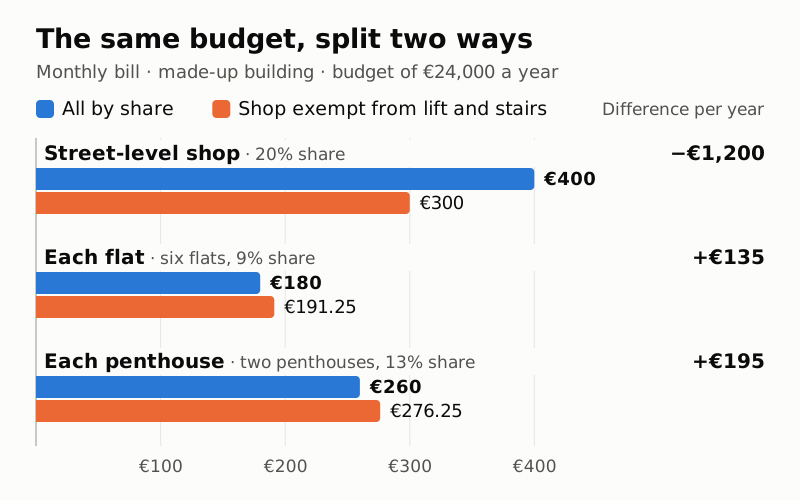
Nothing in the statute exempts a shop that never uses the lift. Nothing forces it to pay regardless, either. The deed or the bylaws decide.
Can the split be changed?
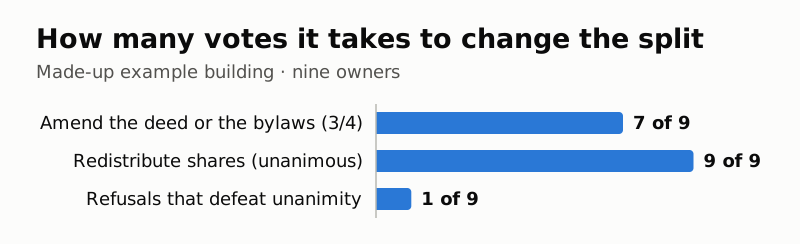
The yearly budget passes by the ordinary majority of article 28, which settles how much is spent and leaves the split alone. Amending the deed or the bylaws needs three quarters of all owners holding three quarters of the shares, and any amendment that redistributes shares needs a unanimous vote (art. 26.1). In our example building there are nine owners, so three quarters means seven people holding 75 hundredths, and one refusal defeats unanimity.
If you live abroad, read this twice. An absent owner who was properly notified and does not object in writing within thirty calendar days of being told of the decision is counted as voting in favour (art. 26.4). Ignore your Andorran post and you have voted yes. The other voting rules are in our guide to the homeowners' meeting.
When the flat is let, sold or held in usufruct
When you let the flat, the community still bills you. What you may recharge is governed by article 22 of Law 15/2022, the consolidated tenancy statute: services that match individual, clearly identifiable consumption, such as the concierge, water, electricity, gas or heating. You must justify the amount, and where there are no individual meters the cost is divided by the floor area of each property. The community charges you by share and you recharge by square metre, so the two figures seldom match. A fixed sum agreed for some or all services is valid.
On a sale, the buyer answers for outstanding community debts with the flat itself, including debts run up by earlier owners, and article 13.3 sets no limit in years. That is why the seller must hand the notary a certificate from the community stating what is owed. Without it the notary cannot authorise the deed unless the buyer expressly waives it.
Where a flat is held in usufruct, the bill and the vote belong to the bare owner. The usufructuary represents the bare owner simply by attending, but needs express authority for article 26 decisions and for extraordinary or improvement works (art. 24.3).
Legal note: a decision contrary to the statute or the bylaws can be challenged before the batlle, the first-instance judge, for one year; for absent owners the clock starts when they are notified (art. 32.4).
Tax for landlords
A tax-resident landlord chooses how to compute expenses on rental income: actual costs, or a flat 40% of gross rent (art. 21 of Law 5/2014). Community fees therefore only matter if you chose actual costs, and the article does not name them. A non-resident has no choice. The taxable base is reduced by 20% and taxed at 10% (arts. 25.2 and 29 of Law 94/2010). As for IGI, Andorra's indirect tax, Law 11/2012 taxes supplies made by businesses and professionals and says nothing about the fees a community shares among its owners. Suppliers' invoices to the building carry it at the general 4.5% rate (art. 57). What you owe at home on the same rent is a separate question for your own adviser.
What do community fees mean in Andorra?
They are each owner's share of the building's general running costs, such as cleaning, the lift and insurance, plus the reserve fund. The share is set in the deed of division (art. 13.1 of Law 12/2004).
Who pays community fees, the landlord or the tenant?
Towards the community, the landlord alone, whatever the lease says (art. 13.3). The landlord may recharge individually identifiable consumption to the tenant.
Who handles property management in an Andorran building?
The owners' meeting, a president chosen from among the owners and an administrator-secretary. Below fifteen units an owner may take that last role unpaid; otherwise it goes to a member of the professional college of property agents (arts. 17, 19 and 21).
Ask the administrator-secretary for a copy of the deed and find your unit's line: one coefficient or two. Then give them an email address for notices. Vecinly keeps meeting minutes and ownership shares within reach of owners who live elsewhere; see our page for international communities.
Information updated 9 October 2026. This article is for informational purposes only and does not constitute legal or tax advice.
Available in 4 languages
Keep reading


Try the specialized platform for your community
Organize maintenance, communication and management easily.