An EV charger in the car park: what the association still has a say in
A neighbour with a new electric car barely needs the meeting's permission in most countries now. What they must notify, what the association can stop and who pays.
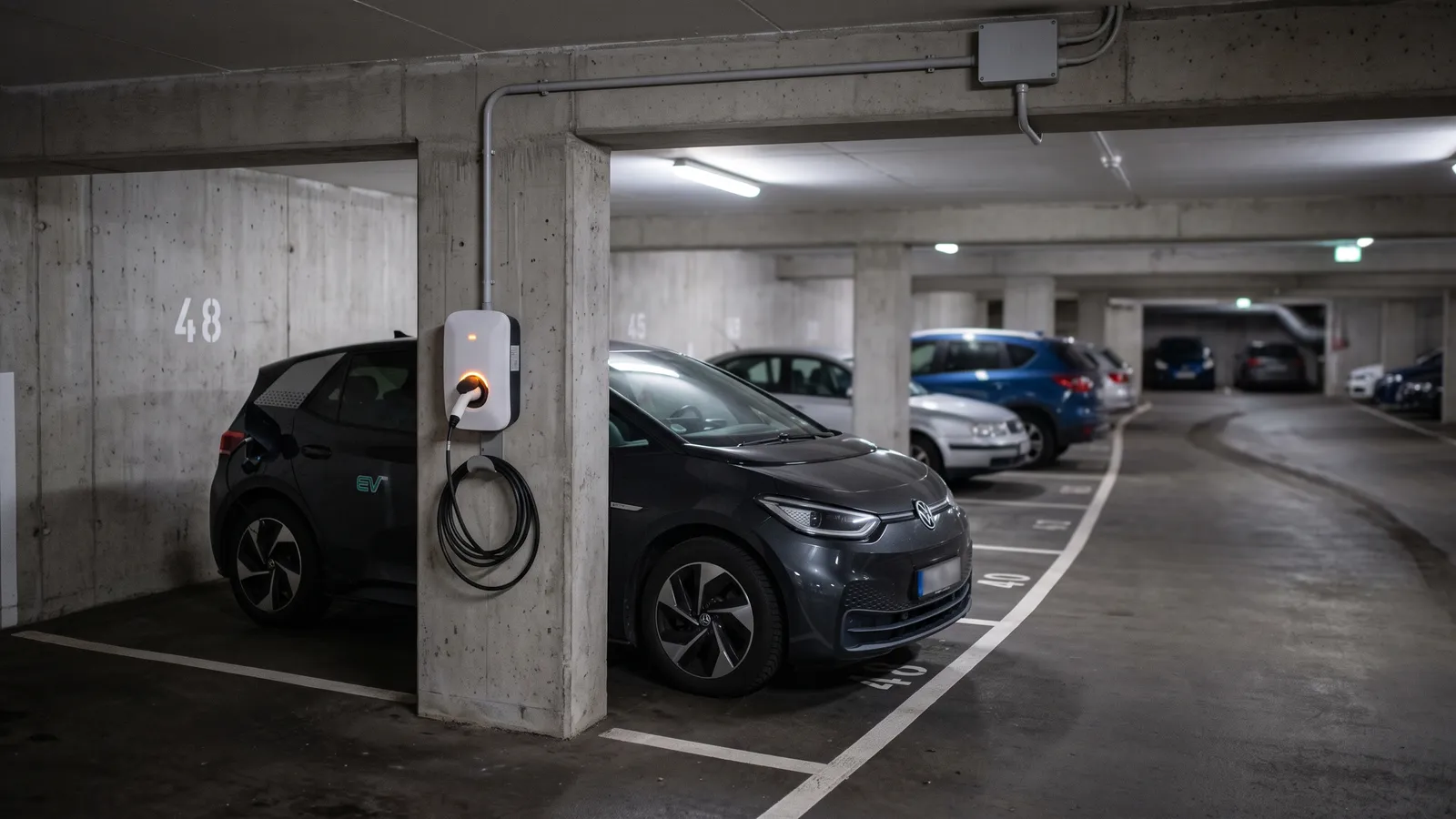
In most of Europe an owner no longer needs a general meeting vote to fit a charger in their own parking bay. In Spain notifying the association is enough (art. 17.5 LPH); in France, Belgium, Portugal and Denmark the owner gives 30 days' to three months' notice and the association can object only on legal grounds. The owner pays.
An extension lead running from the car park's light socket to bay 14 is not a charging point: it is the whole building's electricity bill charging one neighbour's car. The scene plays out in apartment blocks across Europe, nearly always because of the same misunderstanding. The owner thinks the general meeting has to give permission and does not dare ask; the association thinks it can say no. Installing a charger in your own bay has become an owner's right, and the association's role shifts from deciding whether it happens to checking how it is done. What varies is the procedure: in some countries notifying is enough, in others silence counts as consent, and in a few a resolution is still required.
What Europe requires and what is still to come
The European directive on the energy performance of buildings, Directive (EU) 2024/1275, devotes its Article 14 to charging. It has two parts that are worth keeping apart.
The first concerns new buildings and major renovations. A residential building with more than three parking spaces must have pre-cabling in at least 50 % of them and ducting for the rest, so that tomorrow's charger does not mean chasing out walls. New buildings must also have at least one charging point installed.
The second applies to existing buildings: it requires Member States to remove the barriers that stop owners and tenants installing a charging point in a residential building, and to simplify the procedure. The deadline for writing this into national law expired on 29 May 2026, but not every country has done so, and several already had rules of their own.
Country by country: notify, wait or ask permission
The table sums up the general rule for a private charger in the owner's own parking bay. Majorities, exact deadlines and exceptions are set out in the law cited.
| Country | What the owner does | What the association can do | Law |
|---|---|---|---|
| Spain (except Catalonia) | Notify the association before installing | Cannot prevent it or put it to a vote | Ley de Propiedad Horizontal, art. 17.5 |
| Catalonia | Send the technical project to the president or administrator 30 days ahead and the certificate once finished | Propose a reasonable alternative within those 30 days; if it is not built within two months, the owner installs | Catalan Civil Code, art. 553-36.3 |
| Andorra | Run the cabling through common areas to the meters, with a sub-meter | The law gives it no route to object | Llei 12/2004, art. 8.1, as amended by Llei 4/2016 |
| France | Send the syndic a recorded-delivery letter describing the works, with a diagram | Object only before a court, within three months and on serious and legitimate grounds | Code de la construction, L113-16 and R113-8 |
| Belgium | Send a recorded-delivery letter at least two months before work starts | Object within those two months if it shows a legitimate interest | Code civil, livre 3, art. 3.82 |
| Germany | Require the association to authorise the works | Decide how it is done, not whether | WEG, §20.2 and §21.1 |
| Austria | Notify all owners of a slow charger | Object in writing within two months; if it stays silent, it consents | WEG 2002, §16 |
| Italy | Ask the association in writing | Approve it at a meeting; if it refuses or does not reply within three months, the owner may install | DL 83/2012, art. 17-quinquies |
| Portugal | Give 30 days' written notice if the works pass through common areas | Object within 30 days, by a majority of the building's value and only on listed grounds | Decreto-Lei 93/2025, art. 23 |
| Netherlands | Under the 2017 model regulations, notify the board; under older regulations, seek the general meeting's approval | Under the 2017 model no resolution is needed; under older regulations, the general meeting decides | Modelreglement 2017, art. 28 |
| Denmark | Notify the association at least three months in advance | Refuse only on listed grounds; it may ask for security to cover removal | Ejerlejlighedsloven, §§ 4 a–4 d |
| Ireland | Go through the owners' management company, which installs the building's charging network | Decide whether to install that network, with a public grant of 80 % of the cost | SEAI, Apartment Charger Grant |
The grounds on which an association may stop an installation are strikingly similar across countries: suitable shared infrastructure already exists or has been approved, there is a genuine safety risk, the cabling would damage common parts, or the charger would obstruct access routes. Denmark, for example, allows a refusal for unassigned spaces when there is already one charging point per ten; Portugal, when the association installs a shared one offering the same service within 90 days. "The meeting doesn't like it" appears on no list.
The Netherlands is halfway there: the government has put out for public consultation a law that will replace permission with a simple notification to the board, shared parking included, but until it is passed each association's own regulations apply.
Who pays for the works and who pays for the power
Here the laws agree almost without exception: the charger is paid for by whoever installs it. That covers the works, the equipment, the cabling from the meter and, when the time comes, removal and repair of anything that was disturbed. Spain and France say so expressly; Germany frames it as a general rule for any works that benefit a single owner, and Denmark adds liability for damage.
The same goes for the electricity. The clean approach is to run the line from the owner's own flat meter or to fit a dedicated meter for the bay; Andorra requires it expressly, with a secondary device that measures the charger's consumption. Any arrangement in which the charger hangs off the common-areas distribution board, even with a promise that "we'll work it out later", ends in an argument at the meeting that approves the accounts.
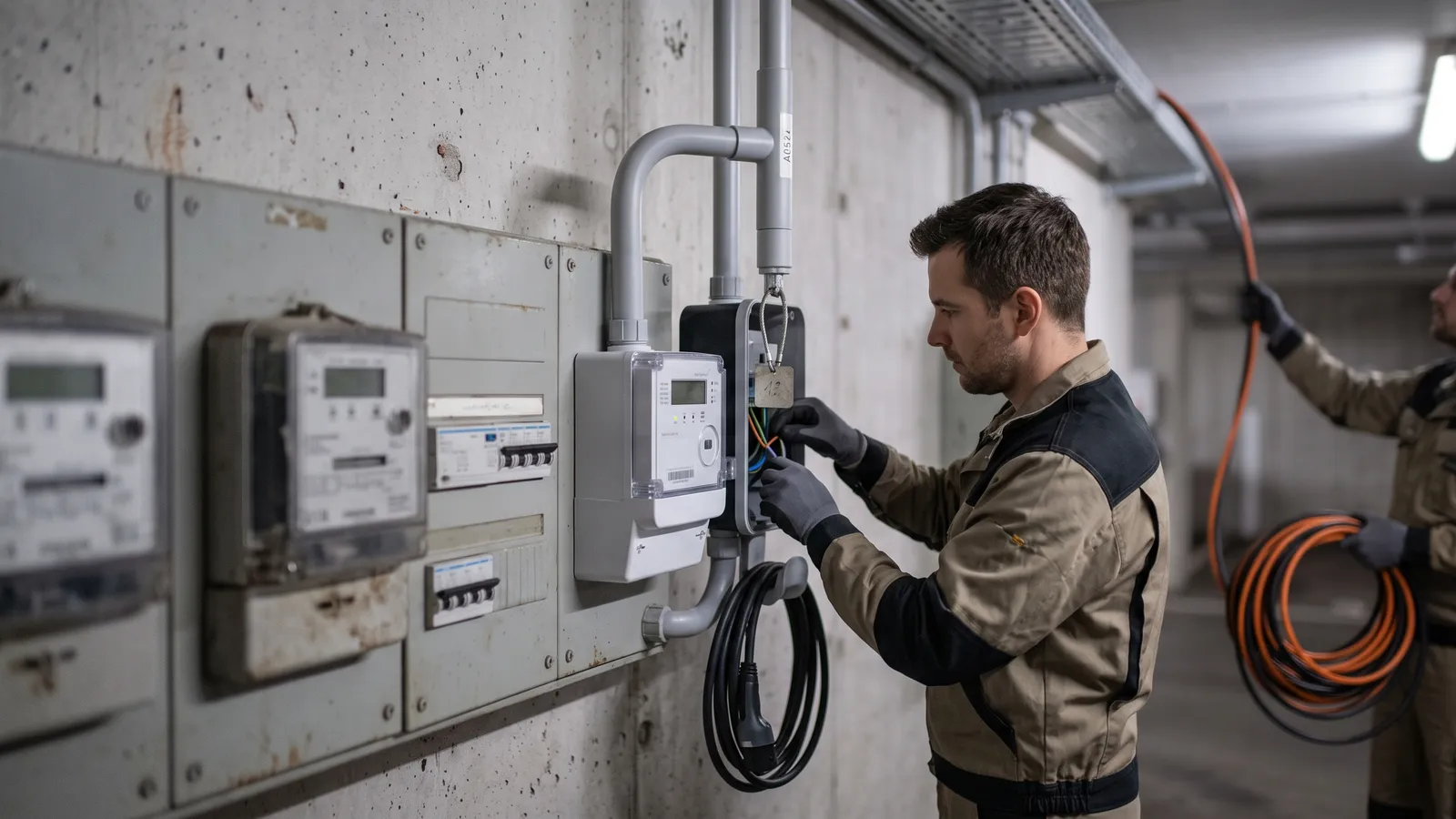
Check the insurance too. The association's policy covers the building, not a neighbour's charger, and a fire in a car park affects every car parked there. Asking the installer for the installation certificate and telling your own insurer costs very little.
What the notice must contain so nobody can knock it down
Where the law only requires notification, the notice is exactly what the association can contest afterwards, and a vague one invites a fight over procedure even when the installation itself is flawless. A well-drafted notice includes:
- The bay concerned and the exact route of the cabling through common areas
- The diagram or technical report from the authorised installer
- Which meter supplies the power and how consumption is measured
- The planned start date and how long the works will take
- A commitment to bear the cost, maintenance and removal
And always in writing, with proof of the date it was received. In France, Belgium and Portugal this is essential: the association's deadlines start running from receipt of the letter, and without proof of the date there is no deadline to rely on.
When the fifth neighbour wants a charger too
The first charger is rarely the problem. The fifth is, when the building's contracted power cannot supply them all at once. At that point individual solutions stop making sense and the association should consider a shared installation: common pre-installation with load management, which each neighbour connects to when they need it.
That decision does go to the general meeting, but with majorities designed so it cannot be blocked: in France, equipping parking spaces with charging points is approved by simple majority (the other French thresholds are in our guide to general meeting majorities in France), and in Germany the works are agreed by simple majority even though spreading the cost across all owners needs two thirds of the votes cast and half the shares. If a German building passes it by simple majority only, those who voted in favour pay, and anyone who voted against can join later by paying fair compensation (§21 WEG).
It is a conversation that goes better with data than with opinions: how many spaces there are, how many neighbours have or plan to have an electric car, and how much power the supply connection can take. In Vecinly, residents' requests are logged with their date, and a poll ahead of the meeting gives everyone a figure to discuss instead of an "I don't think anyone will use it".
Can the association stop me installing a charger in my parking space?
In most countries, no. Spain, Andorra, France, Belgium, Germany, Austria, Portugal and Denmark recognise the owner's right; in Spain and Andorra the law provides no way to object (in Catalonia the association can only propose an alternative within 30 days), and elsewhere the association can only stop it on specific grounds, such as safety or existing shared infrastructure. In Italy it can refuse at a meeting, but if it does, or fails to reply within three months, the owner may install it at their own expense. In Ireland the route is the building's management company, and in the Netherlands it depends on the building's regulations.
Does it have to be voted on at the general meeting?
In Spain, notifying the association before starting is enough; in Catalonia, sending the technical project 30 days ahead. In France, Belgium, Austria and Denmark there is no vote either: the owner gives notice and the association has a set period to object, or listed grounds on which to refuse; in Portugal the association only votes if it wants to object. In Italy the decision lies with the general meeting, in Ireland with the management company, and in the Netherlands with the general meeting unless the regulations follow the 2017 model.
Who pays for installing the charger and for its electricity?
The owner who installs it: the works, the equipment and the consumption, which is best measured through their own meter or a sub-meter. Spain, France, Portugal, Germany and Denmark say so expressly.
Can I charge my car from an ordinary socket in the car park?
Not without the association's agreement. That socket is connected to the common-areas supply, so every owner pays for the electricity. On top of that, a household socket is not designed to cope with hours of continuous charging.
In just a few years, a charger in the car park has gone from a favour asked of the general meeting to works the owner notifies and pays for. What is left for the association is to insist it is done properly: in writing, by an authorised installer, with its own meter and without passing the bill to anyone else. In a German WEG the cable run through the garage touches common property, so it is worth knowing where private and common property begin before the first drill comes out.
Information updated September 2026. This article is for general information only and does not constitute legal advice.
Available in 11 languages
Keep reading


Try the specialized platform for your community
Organize maintenance, communication and management easily.