Fællesudgifter in a Danish ejerforening: what owners really pay
What the common charges of a Danish ejerforening cover, how your share is set by fordelingstal, and why the bill keeps climbing year after year.
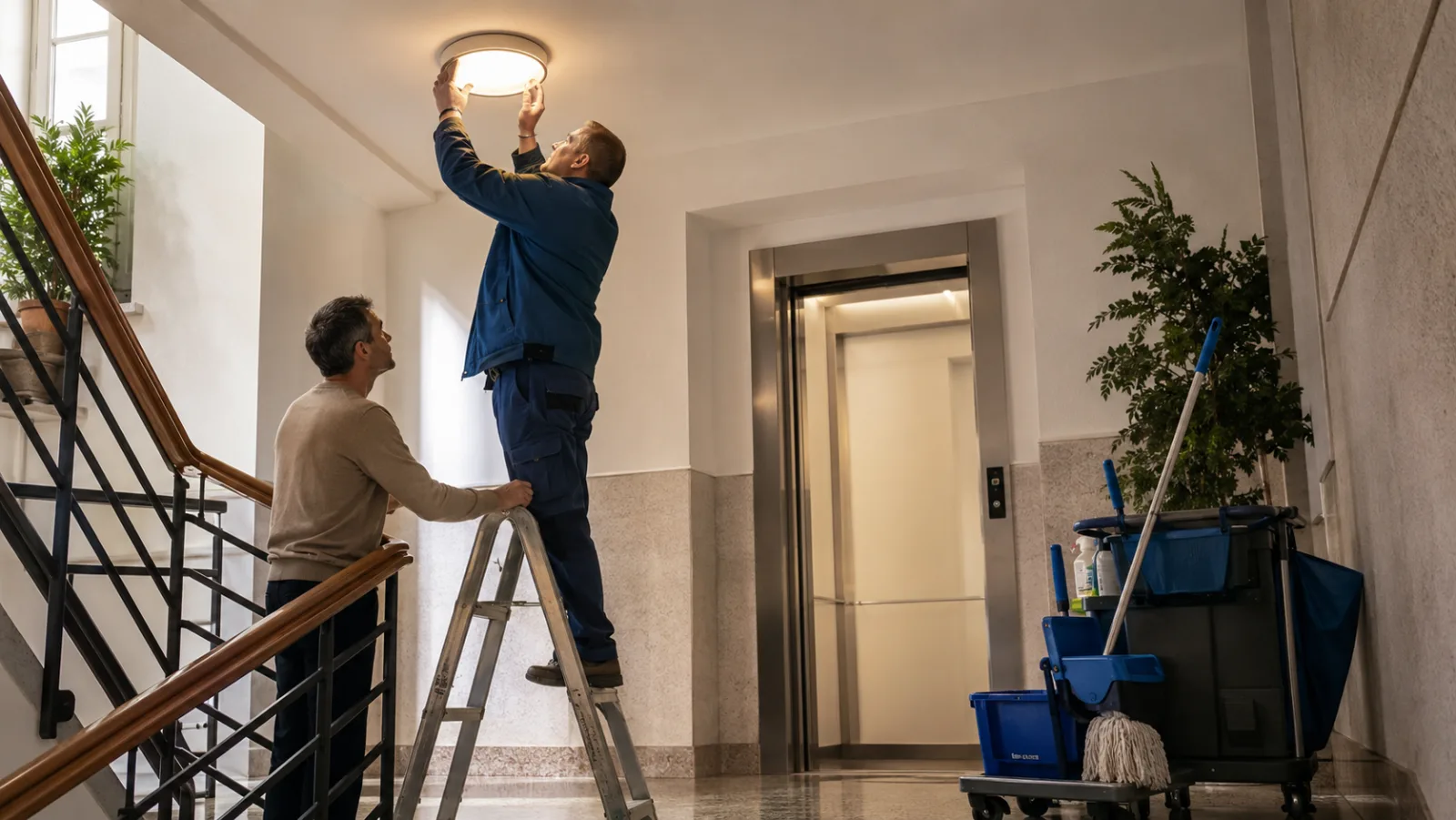
Fællesudgifter are the common charges of a Danish owners' association (ejerforening). They pay for everything the owners share: insurance, cleaning, administration and upkeep of the roof, facade and common installations. Each flat pays according to its registered allocation share (fordelingstal) (section 7 of the Owner-Occupied Flats Act). The budget passes by simple majority at the general meeting and binds every owner.
If you are buying in Copenhagen or Aarhus, the monthly figure in the sales listing is the first thing you will see and the least informative.
What the charges cover, and what they do not
The Act lists land costs, road and sewer contributions, insurance premiums, administration and maintenance of common parts (section 7(1)). Under the standard articles (executive order no. 1738 of 29 November 2020), the association maintains all common parts of the building, including windows, balconies and lifts, and shared supply pipes up to the point where they branch into each flat (section 26). Inside your flat, you pay. Your own heating, water and electricity are usually billed separately, though some associations collect heating on account in the same bill, so read the breakdown rather than the total.
How your share is set
The allocation share is a registered fraction, usually based on floor area; if none was set, every flat pays the same (section 3). If something you did in your flat raises the association's costs, you pay the difference (section 7(2)). Switching consumption costs from allocation shares to individual metering is a significant matter needing two thirds of all owners by both share and number (standard articles, section 4). Owners are personally liable for the association's debts in proportion to their share, but only after the creditor has tried the association (section 1(4)).
Is there a "normal" level?
There is no official statistic on common charges in Danish owners' associations, and figures quoted online say little about a particular building. An older block with a lift and many shared installations costs far more to run than a new one, and a small association has fewer flats to share fixed costs. Judge the charges against the association's own budget, accounts and maintenance plan instead. And do not compare them with a cooperative flat's boligafgift, which also covers the cooperative's mortgage; in an ejerforening your own mortgage comes on top.
Why charges rise
Postponed maintenance is the main driver, followed by contractor and energy prices and insurance premiums after cloudbursts. The standard articles require a maintenance plan to be presented for approval at every annual general meeting (section 9), and the owners can decide to save for specific purposes in a bank account (section 25(2)). When you sell, your share of those savings stays with the association (section 25(4)).
What do fællesudgifter cover in a Danish flat?
Insurance, cleaning, common electricity, administration and maintenance of the building's common parts. Heating, water and electricity inside your own flat are usually billed separately.
How are fællesudgifter divided between owners?
By each flat's registered allocation share (fordelingstal). If none was set, every flat pays the same.
How other European countries set the legal minimum is compared in reserve funds across Europe, country by country.
Before you buy, ask for the budget, the latest accounts, the minutes of the last two or three general meetings and the maintenance plan. For how the budget gets voted, see our step-by-step guide to the general meeting; for what the board answers for, see board liability in a Danish ejerforening. Vecinly shows every owner the budget, actual spending and the maintenance plan side by side, in their own language; see our page on international owners' associations.
Updated September 2026. This article is general information and does not constitute legal or financial advice.
Available in 2 languages
Keep reading


Try the specialized platform for your community
Organize maintenance, communication and management easily.