Umlaufbeschluss: voting without a meeting in a German WEG
A German owners' association can decide by email instead of meeting, but only if every single owner says yes. What your reply does, when a majority is enough, and how long you have to object.

An email from your German property manager asks you to "approve the attached resolution by Friday". If you own the flat from abroad, it is tempting to leave it for the weekend. Under German law that silence decides the matter: a resolution passed without a meeting, an Umlaufbeschluss, is valid only if every owner consents in text form (section 23(3) of the WEG). One missing reply and nothing has been decided.
Your unanswered email is a veto.
Why this differs from a vote in the room
At an owners' meeting only the votes actually cast count, and the majority of them carries the motion (section 25(1)). There is no minimum attendance, so an owner who stays away simply leaves the decision to the others. The written route turns that upside down. The Act asks for the consent of all owners, which includes the one on holiday, the investor who has never seen the building and the heir who has not yet updated an address. Five approvals out of six do not make a narrow resolution; they make none, and an abstention counts for no more than a blank. The government that reformed the Act in 2020 assumed in its own explanatory notes that an association passes such a resolution about once every ten years (Bundestag paper 19/18791, page 36). In a four-flat house where everyone has each other's number it works. With a dozen owners spread over three countries, expect to end up at a meeting after all.
When a majority is enough
Since 1 December 2020 the same section has a second sentence: the owners may resolve that, for one single matter, the majority of votes cast is enough. Germans call this an abgesenkter Umlaufbeschluss, a circular resolution with a lowered threshold. Parliament's legal committee had a specific case in mind: the meeting wants to decide but is still waiting for information, so it votes to finish the decision in writing later (Bundestag paper 19/22634, page 45).
We ran the same replies through the three routes for a six-flat building with one vote per owner.
| Route | 5 yes, 1 silent | 4 yes, 1 no, 1 silent |
|---|---|---|
| Circular resolution, default rule | no resolution | no resolution |
| Circular resolution after a lowering vote for that matter | passed, 5 to 0 | passed, 4 to 1 |
| Meeting called with three weeks' notice | passed, 5 to 0 | passed, 4 to 1 |
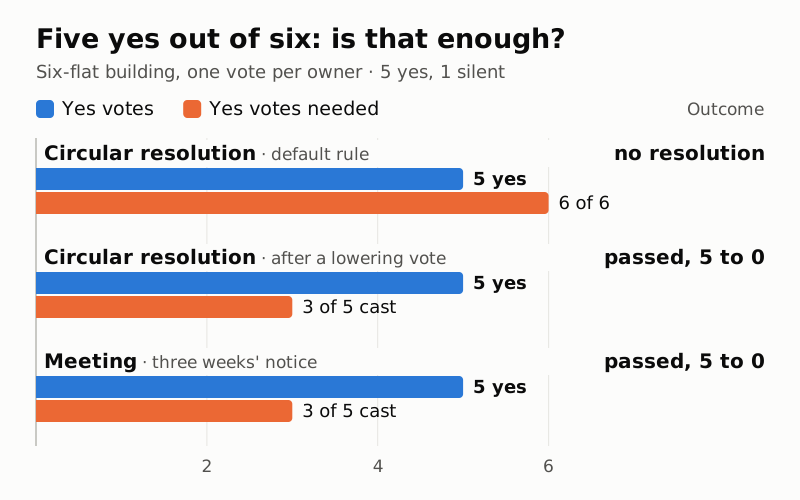
Two things follow from the wording. The lowering vote covers one matter, so a standing rule that "from now on a majority will do" is not what the sentence allows. And because only votes cast count and the Act sets no minimum turnout, in the lowered procedure your silence no longer blocks anything: on the text of the Act a single yes would carry the motion if nobody else replied. If the email in your inbox refers to an earlier vote of that kind, answer it.
How to reply, and what "approved unless someone objects" is worth
Text form means a readable statement that names its author and sits on a durable medium (section 126b of the Civil Code). An email qualifies, and the 2020 explanatory notes also mention online platforms and apps; a yes over the phone does not. Keep a copy of what you sent and when. Vecinly stores each owner's reply next to the resolution text and shows it in the owner's own language, which our page on international owners' associations describes.
Managers sometimes try a shortcut: "we will treat the motion as approved unless anyone objects by the 24th". The Federal Court of Justice dealt with exactly that letter in a Hamburg case about a rebuilt dormer and held that no resolution had come into existence (judgment of 6 July 2018, V ZR 221/17). A written resolution exists only once someone has established the result and told all owners, and that statement cannot be conditional.
The same date starts your clock. An owner who wants to challenge a resolution must sue within one month of its adoption and give reasons within two (section 45). If the result is circulated on Monday 16 November 2026, the last day is Wednesday 16 December. For a meeting, the equivalent date to watch is the invitation, covered in our piece on the notice period for German owners' meetings; if your building has no manager at all, see a German WEG without a property manager.
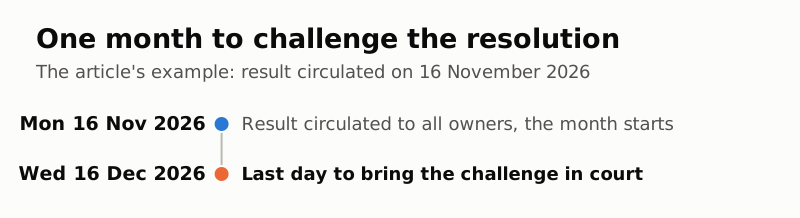
Ask the manager, or whoever keeps the association's register of resolutions, for the date on which the result was announced. German law requires that date to be recorded with the wording (section 24(7)).
As of October 2026. This article is for information only and is not legal advice.
Available in 2 languages
Keep reading


Try the specialized platform for your community
Organize maintenance, communication and management easily.