The maintenance reserve of a German owners' association
German law sets no minimum for the Erhaltungsrücklage, only an adequate one. It stays with the association when you sell, and landlords can deduct it only once it is spent.
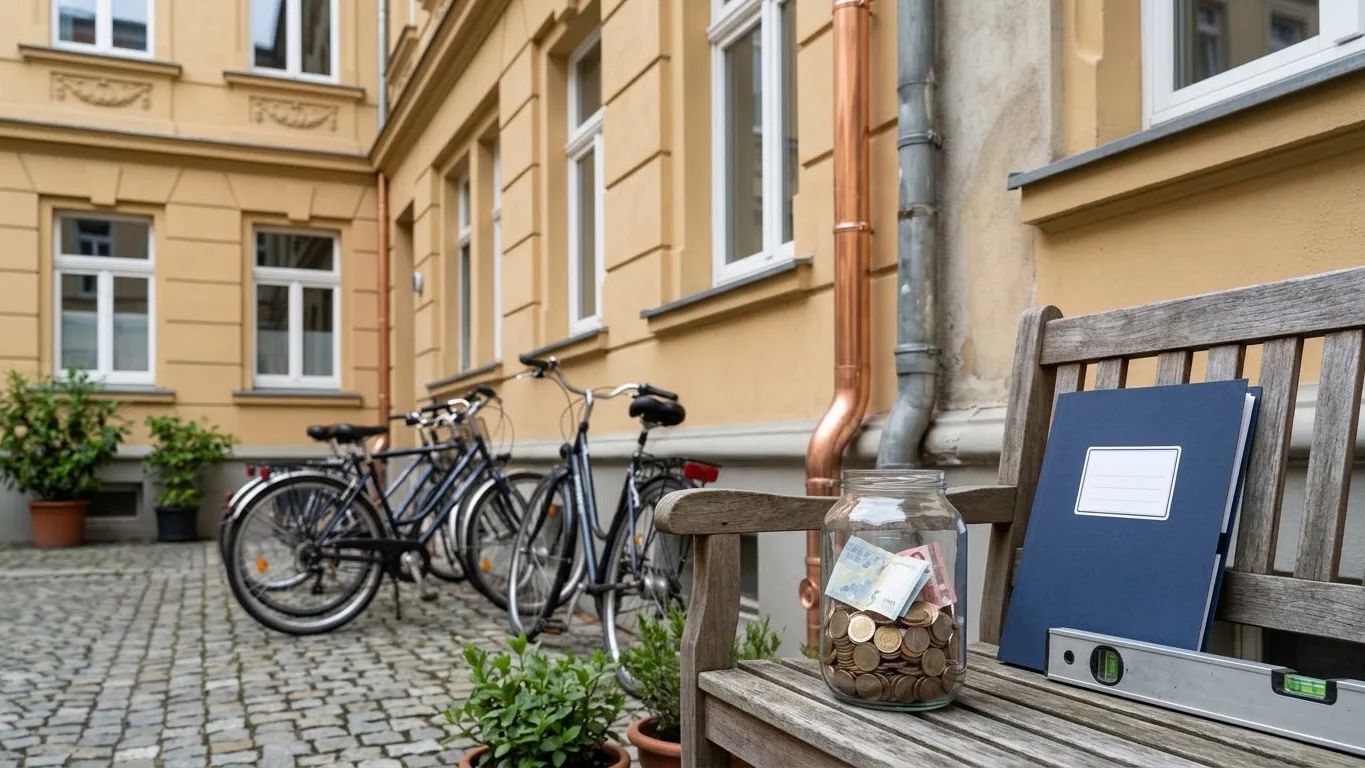
German condominium law sets no minimum amount for the maintenance reserve (Erhaltungsrücklage). It only requires the owners' association to build up an adequate one (section 19(2) no. 4 of the WEG), and the owners vote the contributions every year in the budget (section 28(1)). When you sell, the reserve stays with the association; for tax, contributions count only once the money is spent on repairs.
Until the reform of December 2020 it was called the Instandhaltungsrücklage. Same thing.
How much it should hold
Because the law only says "adequate", the building decides. The most reliable method is a maintenance plan: list the large items due in the next ten to fifteen years, their rough cost and when they fall due. Take a ten-flat building in Leipzig whose roof is due in eight years (about 60,000 euros) and whose heating must be replaced in five (about 30,000). Paying for both without a special levy takes about 7,500 euros a year for the roof and 6,000 for the heating: 13,500 euros, a little over 110 euros per flat per month, before anything else breaks. A reserve pegged to a round figure per square metre rather than to that plan is the one that ends in a Sonderumlage, the special levy owners vote when the money runs short.
Austria does it differently and sets a legal minimum; see our article on the minimum reserve in Austria.
Selling, buying and tax
| Question | Answer | Basis |
|---|---|---|
| Is there a minimum? | No, only an adequate reserve | WEG s. 19(2) no. 4 |
| Who decides the contributions? | The owners, every year in the budget | WEG s. 28(1) |
| Does the seller get their share back? | No, it belongs to the association | WEG s. 9a(3) |
| Does it reduce the buyer's transfer tax? | No | BFH II R 49/17 |
| When can a landlord deduct it? | Only once spent on maintenance | BFH IX R 19/24 |
The reserve is the association's property (section 9a(3)), so a seller takes nothing out; at most it is reflected in the price. The Federal Fiscal Court has ruled that the buyer's real estate transfer tax is charged on the full price, without deducting the share of the reserve (BFH II R 49/17, 16 September 2020).
Landlords cannot deduct contributions in the year they pay them, only when the association spends the money on maintenance, as the same court confirmed on 14 January 2025 (IX R 19/24). Only then is it clear whether the spending is immediately deductible maintenance or a capital cost.
Before buying, ask for the Vermögensbericht, the yearly asset report that the administrator must prepare and make available to every owner, showing the reserve's balance (section 28(4)). A healthy reserve in an old building is a good sign. A thin one in the same building announces a special levy.
How other European countries set the legal minimum is compared in reserve funds across Europe, country by country.
Take a simple list of the big items due in the next ten years to the next owners' meeting and check the reserve against it. Owners who live abroad and rarely attend should at least send a proxy to the meeting that approves the budget: the reserve contribution is voted there, once a year, and it is the line that decides whether the roof is paid from savings or from a levy nobody planned for. How the reserve feeds into the monthly service charge is explained in our guide to Hausgeld, the German condo fee.
Information updated September 2026. This article is for information only and does not constitute legal or tax advice.
Available in 2 languages
Keep reading

Try the specialized platform for your community
Organize maintenance, communication and management easily.