Charges de copropriété in France: how they are split, who pays
French building charges follow two allocation keys written into the rulebook, and the syndic only ever bills the owner. What tantièmes are, when calls fall due, and what changes if you let or sell.
Buy a flat in France in November and, the following spring, the building may send you a bill or a refund for a year you barely owned it. Nothing has gone wrong. French law settles the yearly balance with whoever owns the unit on the day the accounts are approved (article 6-2 of the decree of 17 March 1967).
That rule sits on top of a simpler one. Charges de copropriété are split in two ways under article 10 of the law of 10 July 1965. The cost of maintaining and administering the shared parts of the building is divided in proportion to each unit's tantièmes. The cost of shared services and equipment, such as the lift or collective heating, is divided according to how useful they are to each unit. The grid is written into the building's rulebook and, a few exceptions aside, only a unanimous vote can change it (article 11).
Tantièmes, and why your bill shows more than one column
Tantièmes are your unit's share of the building, usually expressed in thousandths. Article 5 bases them on what the unit consists of, its floor area and its position, with no regard to how it is used. They set your share of the general charges, which cover building insurance, cleaning of the shared areas, meeting costs and the managing agent's fee where there is one. They also give your number of votes at the general meeting.
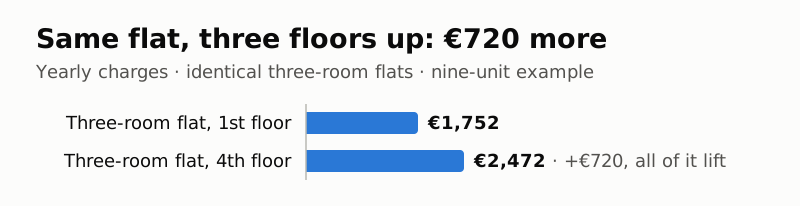
Equipment gets its own column. A lift is charged by usefulness, so a ground-floor shop with its own street door and no cellar pays nothing towards it, while a flat's share rises with its floor. The official guidance adds that what counts is whether you could use the equipment, whether or not you do. We ran the numbers on an invented but ordinary building: nine units over four floors, a yearly budget of 16,800 euros, of which 12,600 is general and 4,200 is the lift. Two identical three-room flats, one on the first floor and one on the fourth, pay 1,752 and 2,472 euros a year.
Same flat, 720 euros apart, all of it lift.
When the money is due
The general meeting votes a budget every year and the syndic, the building's manager, calls it in quarters, due on the first day of each quarter unless the meeting has chosen another rhythm (article 14-1). These calls are provisions. Once the accounts are approved, the difference with what was really spent is credited or charged to each owner. A compulsory contribution to the works fund, at least 5 % of the budget, is called alongside; our guide to the works fund covers it.
Changing the split takes everyone
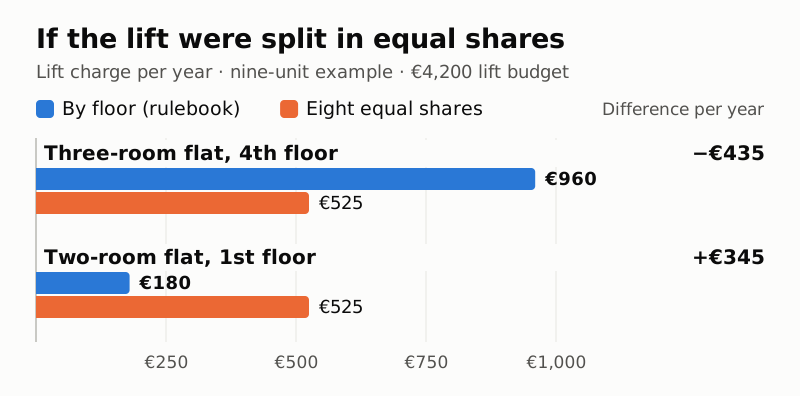
Suppose an owner proposes a simpler grid. In the nine-unit example, splitting the lift into eight equal shares would save the top-floor three-room flat 435 euros a year and cost the first-floor two-room flat 345. A majority cannot pass that. Article 11 requires every owner to agree, with narrow exceptions tied to a specific event: works or a sale of common parts that make a new split necessary, a unit sold off in fractions, a change in how a unit is used and, since 18 June 2025, offices converted into housing (article 24). Asked in 2020 to replace unanimity with a qualified majority, the housing minister declined. A court can rewrite a grid that contradicts the law itself, and the new grid then applies from the following financial year (article 43). How the other votes are counted is in our guide to general meeting majorities.
Letting, selling, usufruct: the building bills the owner
Whoever lives in the flat, the syndic sends the call to the owner. What happens next depends on the situation:
- Letting: you pay the syndic in full and recover from the tenant only the items listed in the decree of 26 August 1987, such as lift running costs, water, collective heating and cleaning of the shared areas, with a yearly settlement (article 23 of the 1989 tenancy law). Building insurance and the syndic's fee are not on that list.
- Buying or selling: the seller owes the budget call already due. Calls for works outside the budget fall on whoever owns the unit on the day they fall due, and the year-end balance goes to the owner on the day the accounts are approved. A different split agreed in the deed binds only buyer and seller (article 6-3 of the decree).
- Usufruct: once the syndic has been notified, the usufructuary pays the running costs and the bare owner the major repairs (articles 605 and 606 of the Civil Code), with no joint liability unless the rulebook provides for it.
- Joint ownership: each co-owner pays according to their share, again unless the rulebook makes them jointly liable.
Tax in brief
Charges on a home you live in are not deductible. If you let the flat unfurnished and are taxed on actual figures (régime réel), you deduct the provisions paid to the syndic during the year and, the year after, add back the part that turned out to be non-deductible or recoverable from the tenant (impots.gouv.fr). Under the simplified micro-foncier scheme, for gross rents up to 15,000 euros a year, a flat 30 % allowance replaces every deduction (article 32 of the tax code). The calls themselves carry no VAT (official tax doctrine).
Before you sign, ask the notary for the règlement de copropriété and for the état daté, the statement the syndic draws up for the sale: it lists what the seller still owes the building and what will fall to you. If the building is run by one of its owners rather than a firm, our guide to the volunteer syndic explains who you will be dealing with, and Vecinly's page for international communities shows how notices and accounts reach owners abroad in their own language.
Information current as of 8 October 2026, checked against the consolidated texts of the law of 10 July 1965 and the decree of 17 March 1967. This article is for information only and is not legal or tax advice.
Available in 2 languages
Keep reading


Try the specialized platform for your community
Organize maintenance, communication and management easily.