Ejerforening bylaws in Denmark: which rules bind you as an owner
A Danish flat comes with default bylaws set by the state and, often, a registered set of the building's own. How to tell which apply, what a two-thirds vote can change and what it cannot.

Somewhere in the sales pack for your Danish flat there is a document called vedtægter. It may be four pages from 1987 or forty from last year, and it is nearly always in Danish only. Do you have to read it?
Yes, but read the right one. Every owners' association (ejerforening) is governed by the state's standard bylaws (normalvedtægt), which apply automatically unless the owners have validly departed from them (section 5(2) of the Owner-Occupied Flats Act). Anything the building has adopted on top is a special bylaw (særvedtægt), and it only holds against a buyer acting in good faith if it is registered on each flat in the land register (section 5(3)).
Two layers, and the older one can still win
The current standard bylaws date from 2020 and have applied to every association since 1 January 2022, including those founded decades earlier. They cover meetings and the board, voting thresholds, upkeep, letting, and sanctions.
A building's own registered bylaws sit above them. The ministry's 2025 guidance explains how the two interact: an older special bylaw stays in force, and the 2020 text only fills the gaps it leaves. That includes one case that catches people out. Some associations registered the previous standard text from 2004 as their own, to be on the safe side. For them that 2004 text now counts as a special bylaw and still applies, even where the 2020 version is kinder to owners. One example from the guidance: under the 2004 text owners were jointly and severally liable for the association's debts, while the 2020 text limits each owner to a share in proportion to their ownership fraction (section 1(4)). So two neighbouring buildings of the same age can run on different rules, and the only way to know which is yours is to look at what is registered on the flat.
Ask the seller's agent for the registered version, not the copy in the board's folder.
What your neighbours can change without you
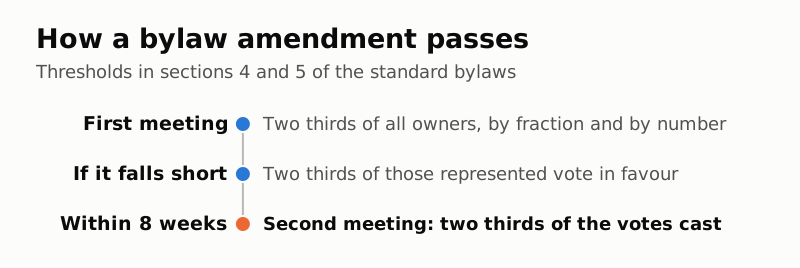
Amending the bylaws takes two thirds of all owners, counted both by ownership fraction and by number of flats (section 4 of the standard bylaws). Absent owners count against the proposal. If the meeting falls short but two thirds of those represented vote in favour, a second meeting within 8 weeks can pass it with two thirds of the votes cast (section 5). The mechanics are in our guide to the Danish general meeting.
There are limits. A change that shifts the balance between owners, cuts back a specific owner's rights or imposes new duties also needs the consent of the owners who lose out (section 7). Three points matter most to someone who does not live in the flat all year:
- Short lets: the association can restrict lets of under 31 days by a two-thirds vote, but you keep the right to 4 separate lets and at most 30 days per calendar year (section 30(2)). Any tighter restriction on letting needs your consent.
- Ordinary lets: you must tell the board about the tenancy, its length and the tenant's name and contact details no later than the day it starts (section 30(1)).
- House rules: the husorden is passed by simple majority and may only cover day-to-day order, such as quiet hours and use of the courtyard. It cannot ban pets or letting, because those need a qualified majority or consent (section 6 of the Act).
Some rules cannot be voted away at all. Fines of up to 10,000 kr. for gross breach of duty, exclusion, and the association's right of access to your flat with 6 weeks' written notice come straight from the Act (sections 8 to 10).
The 50,000 kr. entry in the land register
Foreign buyers are often alarmed by a charge registered on the flat in favour of the association. It is usually no debt at all. Section 31 of the standard bylaws lets an association register its bylaws as security for 50,000 kr. on every flat, to cover unpaid common charges and other claims against the owner. It ranks behind the mortgages already on the flat when it was registered.
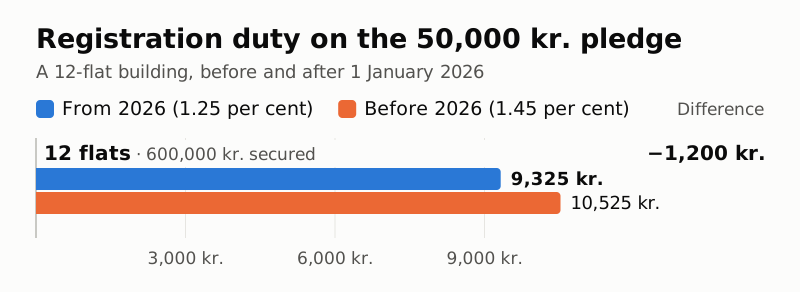
Setting it up is the association's cost, shared by ownership fraction. Registration duty is 1,825 kr. plus a percentage of the total secured amount, and that percentage fell from 1.45 to 1.25 per cent on 1 January 2026 according to the Ministry of Taxation's rate table. By our calculation a 12-flat building pays 9,325 kr. (600,000 kr. secured), against 10,525 kr. before the change. The bylaws themselves cost a flat 1,850 kr. to register, however many flats there are.
What is an ejerforening in English?
An owners' association: the compulsory body made up of all owners of flats in a Danish building divided into owner-occupied units. You become a member when you take over the flat and cannot opt out.
What does vedtægter mean in English?
Bylaws, sometimes translated as articles of association. In an ejerforening they are the standard bylaws issued by the ministry plus any special bylaws the building has adopted and registered.
If you sit on the board of a building with owners abroad, send them the registered bylaws rather than a summary. Vecinly keeps bylaws, minutes and votes in one place and its interface is available in eleven languages, English included; see how it works for international communities.
Updated October 2026. This article is general information and does not constitute legal advice.
Available in 2 languages
Keep reading


Try the specialized platform for your community
Organize maintenance, communication and management easily.