Snow clearing duties for an Austrian owners' association
Clearing the pavement is not a neighbourly gesture but a legal duty with full liability attached. Who carries it, and how to hand it over properly.
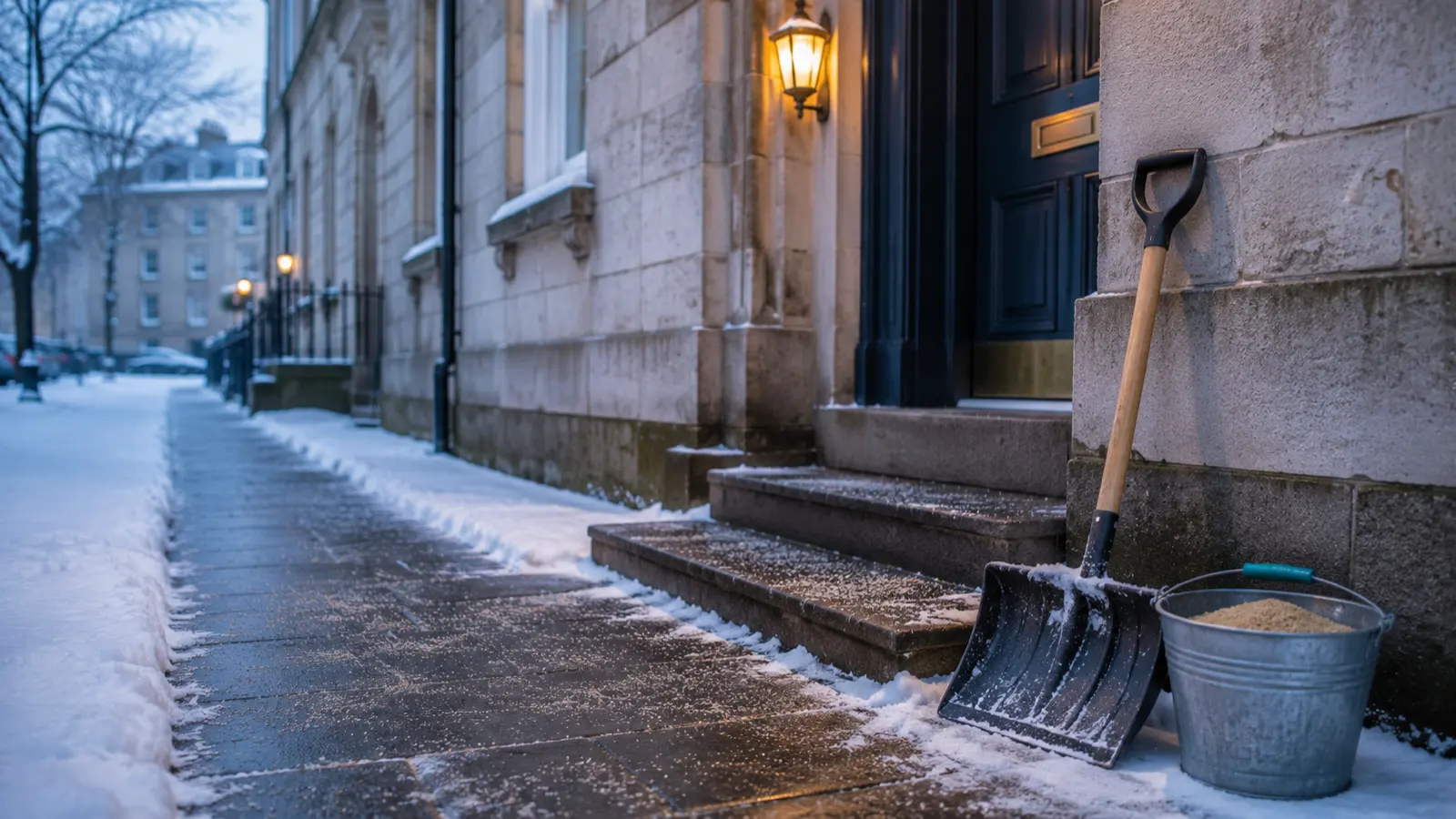
In Austrian towns, property owners must keep the pavement along their building clear of snow and gritted from 6 am to 10 pm, and remove icicles and snow overhangs from the roof (section 93 of the Road Traffic Act, StVO). In a condominium that duty falls on all the co-owners, organised through the owners' association, and liability starts at simple negligence.
If you own a flat in Innsbruck or Vienna and spend the winter elsewhere, this is the duty most likely to reach you by post: a fall on an icy pavement, a lawyer's letter to the manager, and a claim the association pays from everyone's contributions.
What has to be cleared, and when
The duty covers public pavements and footpaths running along the whole property within three metres of the boundary, including steps along them. Where there is no pavement, a one-metre strip at the edge of the road must be cleared and gritted. Clearing once in the morning is not enough: if snow starts at 3 pm, it has to be cleared again that afternoon. Icicles and snow on roofs facing the street must be removed with no time limit, and a barrier tape is only allowed for the duration of the work.
Why liability is stricter than people expect
Whoever maintains a road or path is normally liable only for gross negligence (section 1319a ABGB). That privilege does not help here. Austria's Supreme Court holds that a property owner under section 93 StVO is not a path keeper and is liable for simple negligence as well (OGH legal principle RS0030023). One afternoon without gritting can be enough. Check the building's liability insurance before the first snow: the cover amount, and whether winter service is expressly included.
Handing the duty over
If the duty is transferred by contract, the person who takes it on steps into the owner's place (section 93(5) StVO). That can be a winter-service firm, a caretaker or a resident. A contract promising "winter care as required" is of little use after an accident; it should name the areas, the hours including weekends, and when the crew turns out. For the paths within the property, such as the drive or the courtyard, the association stays liable after handing them to a firm for its own fault in choosing or supervising it, and simple negligence is enough there too (RS0124737). Ask for monthly logs with date, time and work done; when a claim arrives two months later, the log for 14 January at 7 am decides it.
The cost of winter service is split by co-ownership share like any other building expense (section 32 WEG 2002). A tenant does not carry the duty by law, and writing it into a lease helps only if the tenant actually does the work.
When must snow be cleared in Austria?
Every day between 6 am and 10 pm, as often as the weather requires (section 93(1) StVO). Snow and ice on the roof must be removed at any time.
Does the tenant have to clear snow in Austria?
Not by law; the duty lies with the property owners. A tenant who takes it on by contract steps into their place.
Settle before the first frost who clears what, when, and who checks. Associations without a manager should read is a property manager mandatory in Austria?, and the cost shows up in the condominium annual statement. Vecinly puts the winter-service resolution and the logs where every owner can find them, in their own language; see our page on international owners' associations.
Information updated September 2026. This article is for information only and does not constitute legal advice.
Available in 2 languages
Keep reading

Try the specialized platform for your community
Organize maintenance, communication and management easily.