Betriebskosten in Austria: what flat owners pay and why
The monthly charge on an Austrian flat follows a figure called the Nutzwert, not the floor area. What it covers, who can change the split and what a buyer inherits.
A sale listing for a flat in Vienna says "BK € 284". Buyers from abroad tend to read that as a fee per square metre, or as something a tenant will cover in full. Neither is right. In an Austrian condominium the running costs of the building, reserve fund included, are split in proportion to each owner's co-ownership share (section 32(1) of the Condominium Act, WEG 2002), and that share comes from a figure called the Nutzwert. A different split needs the written agreement of every owner or a court order.
What the monthly demand contains
The Act has no list of items. It speaks of "expenses for the property including contributions to the reserve", which is wider than what a tenant calls Betriebskosten. A typical monthly demand (Vorschreibung) has three parts: day-to-day running costs such as water, refuse collection, building insurance, cleaning as well as the manager's fee; shared installations such as the lift; and the reserve, whose legal floor is explained in our piece on the minimum reserve fund. These are advance payments, due on the fifth of each month unless the owners have agreed otherwise, and they are reconciled once a year in the annual statement.
Why two flats of the same size pay different amounts
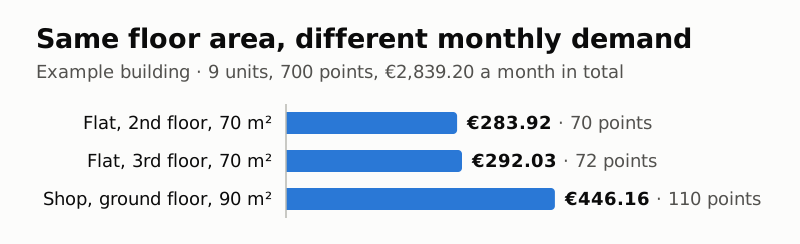
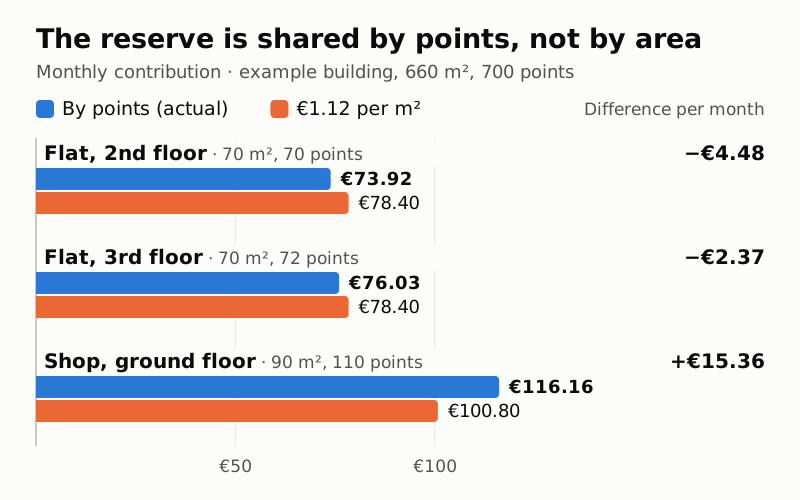
We ran the numbers on an invented building of nine units: a shop and eight flats, 660 square metres of floor area, 700 Nutzwert points and a monthly demand of 2,839.20 euros for the whole house. A 70 square metre flat on the second floor carries 70 points and pays 283.92 euros. The identical flat one floor up carries 72 points and pays 292.03 euros. The ground-floor shop, with 90 square metres and 110 points, pays 446.16 euros. The points are not voted on. A chartered engineer or court-certified expert fixes them in a written valuation (section 9), starting from the floor area and adjusting for the unit's use, its floor level, any balcony or terrace, plus extras such as a cellar compartment. Your share appears in the land register. One detail confuses even long-standing owners: the legal minimum for the reserve, 1.12 euros per square metre a month in 2026, is calculated for the building as a whole and then shared out by points. The 70-point flat pays 73.92 euros into the reserve, not 78.40.
Can the split be changed?
Rarely, and never by an ordinary majority. The routes the Act allows are short:
- All owners sign a written agreement on another key or a separate accounting unit; it applies from the next accounting year at the earliest.
- Owners holding two thirds of the shares vote to bill a metered cost, such as cold water, by consumption.
- A single owner asks the district court to set a new key because the possibilities of use differ considerably.
The lift is the standard dispute. Ground-floor owners pay towards it by default, and the Supreme Court measures the objective possibility of using it, not whether anyone does (OGH legal principle RS0083193). Where the lift only takes an owner to shared rooms in the basement, the same line of cases usually grants relief of four fifths. In our building that would move 44 euros a month from the shop to everyone else, about 5 euros for a mid-sized flat.
One fifth of the lift usually stays with the ground floor.
Letting the flat
The association bills the owner, whoever lives there. What you may pass on depends on the building's age. Where the Tenancy Act applies in full, only the items listed in section 21 MRG can be charged to the tenant, and the reserve is not among them. For a condominium flat in a building put up under a permit issued after 8 May 1945 those rules do not apply (section 1(4)), so the lease decides.
If you live abroad, deal with the post. Resolutions are sent to the flat itself unless you have given another address in Austria, and you can ask to receive them electronically (section 24(5) WEG). The time limit for challenging a resolution runs from the day it is posted in the building.
Buying: the seller's arrears, and one catch
A buyer is not personally liable for what the seller owes (RS0119209). The flat itself can still answer for it.
The association has a statutory lien on every share (section 27 WEG). It bites on a buyer only if the association sued within six months of the debt falling due and applied to have the claim noted in the land register before the buyer filed for registration (RS0114609).
So read a fresh land register extract just before signing. A second trap is the annual statement: a shortfall is owed by whoever owns the flat on the day it falls due, even if it relates to the seller's year (section 34(4)).
Tax and VAT
Charges on a home you live in are not deductible (section 20 of the Income Tax Act). On a flat you let they count as income-related expenses (section 16), while major repairs to residential buildings are spread over fifteen years (section 28(2)). How the rent is taxed when you live outside Austria is a question for an adviser. The demand itself usually carries VAT: 10 % for homes (section 10(2) of the VAT Act), 20 % for heat and parking spaces, and none for business premises. A small building can fall under the 55,000 euro small-business threshold and bill without VAT.
What are Betriebskosten?
For a flat owner in Austria they are the building's shared costs: running costs, shared installations such as the lift, and contributions to the reserve. They are billed monthly as advance payments.
What does Betriebskosten include?
Typically water, sewer, refuse, chimney sweep, lighting of shared areas, building insurance, cleaning, plus the manager's fee where there is one. An owner's monthly demand also includes the reserve contribution, which a tenant under the Tenancy Act does not pay.
What is Betriebskosten in English?
Operating costs or service charges. For owners the legal term is "expenses for the property" (Aufwendungen für die Liegenschaft), in section 32 of the Condominium Act.
Nutzwert vs Nutzfläche
Nutzfläche is the floor area in square metres. Nutzwert is a points figure built on that area and adjusted for the floor level, the unit's use and features such as a balcony. Costs are split by Nutzwert.
Before you sign, or before your next owners' meeting, ask for the land register extract, the Nutzwert report and any written agreement on a different split. In a building that runs itself without a manager the calculation is often one neighbour's spreadsheet; software such as Vecinly works out each unit's demand from the shares.
Updated October 2026. This article is general information on Austrian law and is not legal or tax advice.
Available in 2 languages
Keep reading


Try the specialized platform for your community
Organize maintenance, communication and management easily.