The maintenance plan of a Danish ejerforening: rules and money
Danish law does not require a maintenance plan, but the standard bylaws do. What the plan must contain and how a surveyor's list of works turns into a monthly figure.
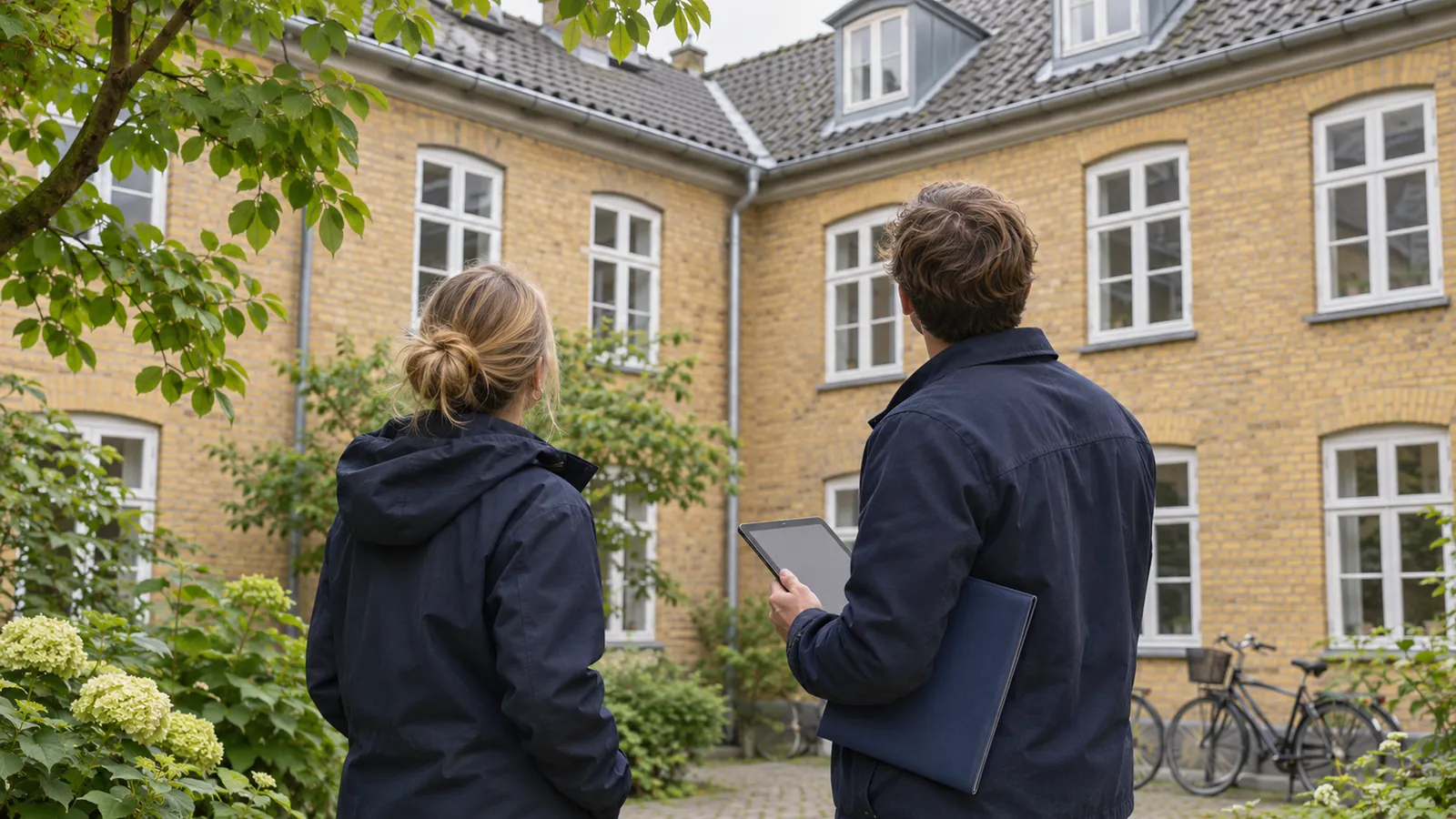
You are buying a flat in a 1930s block in Copenhagen, and the estate agent hands you a thick pack from the ejerforening, the owners' association every flat owner belongs to. Somewhere in it is the vedligeholdelsesplan, the maintenance plan. It is the document that tells you whether the roof will be paid for gradually or land on you as a single bill.
The Owner-Occupied Flats Act (ejerlejlighedsloven) does not require one. The standard bylaws do. Every association whose own registered bylaws do not say otherwise is governed by the normalvedtægt of 2020, which tells the board to prepare a maintenance plan (section 16(2)(6)) and puts it on the agenda for approval at every annual general meeting (section 9(1)(4)). The housing ministry's 2025 guidance reads it the same way. The Act imposes no duty; the standard bylaws make the plan mandatory.
What the plan has to contain
There are no formal requirements. According to the guidance, the plan should list the major works needed to keep the building in sound condition, each with its due date and an estimate of the cost. It covers only what the association maintains under section 26: roof, facade, shared installations, windows, balconies, lifts, doors onto common areas, and supply pipes up to the point where they branch into each flat. Emergency repairs have no place in it. Planned renewals do.
The bylaws set no time horizon. In practice a useful plan looks 10 to 15 years ahead and is reviewed every year before the budget.
Who prepares it
The board is responsible, and the guidance expects it to bring in professional help where needed. Usually an engineer or building surveyor inspects the property and delivers the plan. There is no standard fee. It depends on the size and age of the building and on how much inspection is included, so the board should get at least two quotes. The fee is shared like any other common cost.
A worked example
Take an association of 12 flats in a building from 1934, with equal ownership shares. The surveyor's ten-year plan looks like this:
| Element | Year | Estimate incl. VAT |
|---|---|---|
| Courtyard facade, repointing | 2027 | DKK 350,000 |
| Stairwells, paint and lighting | 2028 | DKK 120,000 |
| Roof, new tiles and battens | 2030 | DKK 1,400,000 |
| Soil stacks, pipe relining | 2033 | DKK 900,000 |
| Inspections, gutters, drains | yearly | DKK 40,000 |
That is DKK 3.17 million over ten years. Paid project by project, each flat faces a one-off charge of about DKK 116,700 for the roof in 2030. Spread evenly, the plan costs DKK 317,000 a year, or about DKK 26,400 per flat. That is roughly DKK 2,200 a month on top of the ordinary common charges.
Is there a mandatory reserve fund?
No. Older texts speak of a grundfond, a maintenance fund under section 12 of the 2004 standard bylaws. The 2020 version replaced it with two options in section 25. The association may charge enough to build reasonable equity, which the guidance puts at 6 to 12 months of running costs, built up over 5 to 10 years. The general meeting may also decide to save for a specific purpose, such as the 2030 roof. That money sits in a bank account, and the general meeting decides how it is spent. Neither is a legal obligation, although an older registered bylaw or the listing declaration of a protected building may still require a fund.
A seller cannot take their share of the savings with them (section 25(4)). The money stays with the association, and the buyer of the flat benefits from it.
Votes
The plan, the budget and ordinary maintenance pass by simple majority of ownership shares (section 3), however expensive the work. A project that changes the building, such as adding balconies, needs two thirds of owners by both shares and headcount (section 4(2)). The board can order routine work within the budget and urgent work outside it. Anything else goes to a general meeting, as described in our guide to the general meeting step by step.
What to check as a buyer
The association fills in an ejerlejlighedsskema, an information form on its finances and the state of the building. Ask for the plan itself as well. Check that it has been updated in the last year and that the large items of the next five years are covered by savings or by the budget. Then ask whether any works have been approved but not yet charged to the owners.
Read the maintenance plan with the budget open beside it. If the association keeps both in one place, for example in Vecinly, owners and buyers can see where the roof money is meant to come from.
Information updated in November 2026. This article is for information only and does not constitute legal advice.
Available in 2 languages
Keep reading


Try the specialized platform for your community
Organize maintenance, communication and management easily.